Best Greyhound Betting Sites – Bet on Greyhounds in 2026
Loading...
Greyhound punters study form, trap draws and sectional times with rigorous attention. Then they ignore the weather. It is a blind spot so widespread that it barely registers as one — yet track conditions are the single variable most likely to invalidate everything the race card tells you. A dog with blazing sectional splits on a dry, fast surface may struggle through the same race on a rain-soaked track where the sand is heavy and the rails are slick. The form figures say one thing. The forecast says another. Smart bettors check both.
Weather does not affect all dogs equally, which is what makes it a betting variable rather than just background noise. Early-pace dogs, heavy dogs, closers, railers — each running style interacts differently with changes in going, temperature and wind. Understanding those interactions gives you an analytical edge that the race card alone cannot provide, because the race card records what happened under past conditions, not what will happen under today’s.
How Rain Affects Track Surface and Running Rails
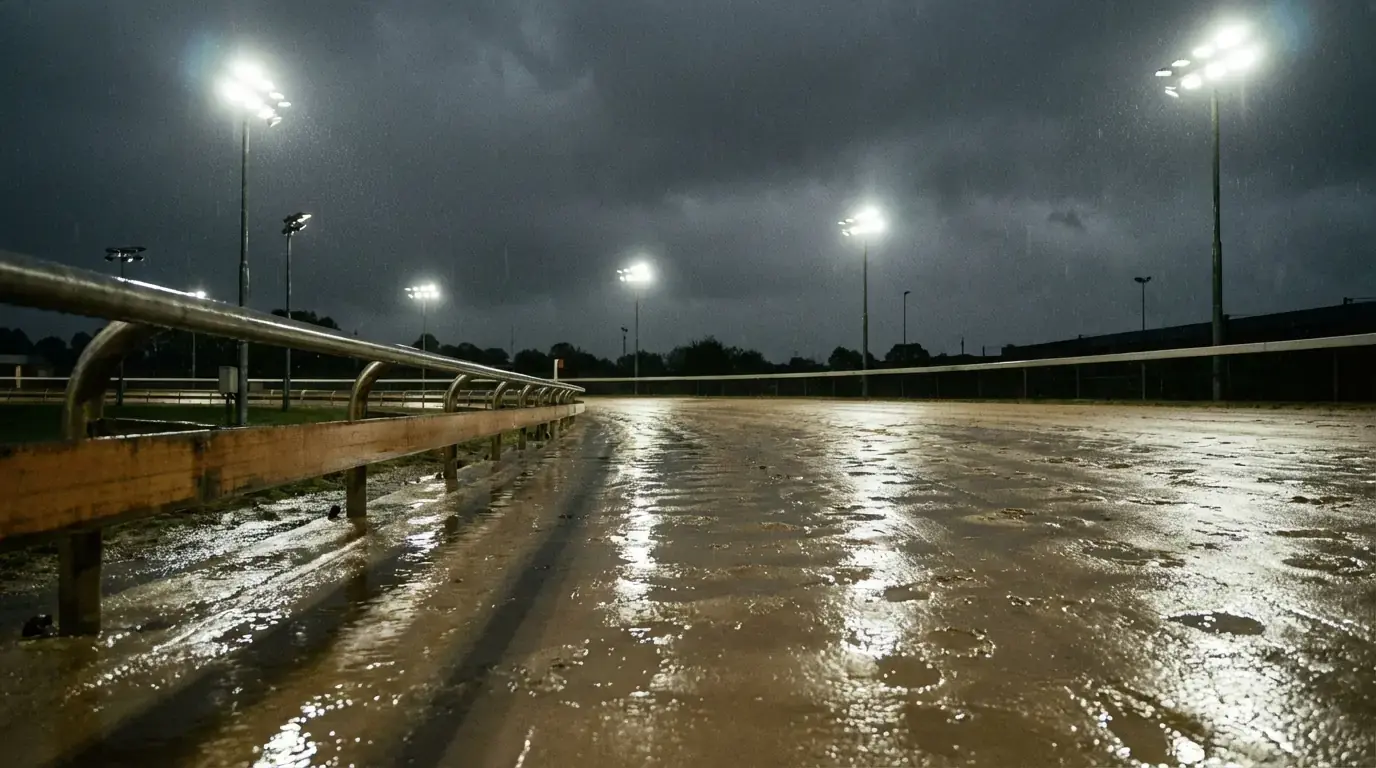
UK greyhound tracks use sand-based racing surfaces. The composition varies between venues — some use finer silica sand, others use coarser builders’ sand with added minerals — but all respond to water in broadly the same way. Light rain dampens the surface and can actually produce faster times: the moisture binds the sand slightly, reducing the loose give that absorbs energy on dry surfaces. Moderate to heavy rain has the opposite effect. The sand becomes waterlogged, heavy, and slow. Dogs have to work harder with each stride, and finishing times lengthen noticeably.
The impact is not uniform across the field. Heavier dogs are disproportionately affected by wet going because they sink deeper into the soft surface with each stride. A dog racing at 33 kg on a heavy track expends measurably more energy per stride than a dog at 28 kg, and that difference compounds across a 480-metre race. If you notice a consistently heavy dog in the field and the forecast calls for rain, reduce your confidence in that runner regardless of its dry-track form.
Early-pace dogs are particularly vulnerable to wet conditions. Their advantage depends on breaking fast and establishing a lead by the first bend. On a heavy surface, the initial burst from the traps is slower for everyone, but the energy cost of that burst is higher. Dogs that rely on explosive early speed may use a disproportionate amount of their energy reserves in the first 100 metres, leaving less in reserve for the back straight and final bend. Closers, which conserve energy through the early phases and accelerate later, tend to benefit from wet conditions because the leaders tire earlier.
The running rails are another factor. On a wet track, the inside rail — where the surface sees the most traffic and wear — can develop a strip of softer, deeper sand. Dogs running tight to the rail (railers) effectively run on the worst part of the surface, while dogs taking a wider path find slightly firmer ground. This can shift the normal trap bias at a venue. A track where trap 1 dominates in dry conditions may see that advantage reduced or even reversed on a wet evening. Checking whether the rail has been moved recently (tracks adjust rail positions to distribute wear) adds another layer: a freshly repositioned rail may expose an untested section of surface that behaves unpredictably in the wet.
Persistent rain over multiple days affects conditions even more. Drainage systems vary between tracks. A well-drained venue might recover from overnight rain by the afternoon card. A poorly drained track might remain heavy for 48 hours. Local knowledge — or a quick check of social media posts from track-goers — can tell you more about the actual going than any weather forecast.
Wind, Temperature and Seasonal Patterns
Wind is the most underappreciated weather factor in greyhound racing. UK tracks are open-air venues, and strong crosswinds or headwinds along the back straight can materially affect race dynamics. A headwind on the back straight penalises front-runners who are already working hard to maintain their lead, while closers running in the slipstream of the field are partially shielded. Crosswinds on the bends can push dogs off their line, particularly lighter dogs with less mass to resist the lateral force.
Most punters never check wind conditions before betting. This creates an edge for those who do. A simple check of the wind speed and direction at the track location — available from any weather app — combined with knowledge of the track’s orientation tells you which sections of the circuit will be affected. If the back straight runs east-west and a 30 mph westerly is blowing, every dog will face a headwind on the back straight and a tailwind on the home straight. Front-runners covering the back straight in the lead will absorb the full force of the wind. Closers making their move on the home straight will get an aerodynamic assist. The maths of the race shifts, and the odds rarely reflect it.
Temperature affects greyhounds physically. Dogs perform best in moderate temperatures — roughly 8 to 18 degrees Celsius. In cold conditions (below 5 degrees), muscles take longer to warm up, and dogs that have been waiting in the kennels for several races may be stiff at the traps. In hot conditions (above 22 degrees, which is rare but not unknown during UK summer evenings), overheating becomes a concern, particularly for heavier dogs and those with thick coats. Hot conditions can also dry out the sand surface rapidly, changing the going from race to race across a single card.
Seasonal patterns matter at a broader level. Winter racing in the UK means colder surfaces, shorter daylight hours, and more frequent rain. Form from summer months may not translate directly to winter performance because the going, the temperature and the race scheduling (with more BAGS daytime meetings and fewer evening cards) all differ. A dog that peaked in August on fast, dry surfaces may underperform in January on heavy, cold going. Treating seasonal context as part of the form picture — rather than assuming form is constant year-round — adds a useful dimension to your analysis.
Adjusting Selections for Adverse Conditions
The practical question is what to do differently when conditions are poor. The adjustments are specific and actionable.
On wet tracks, favour lighter dogs over heavier ones at the same grade level. Reduce your confidence in dogs whose form is built on dry-track speed — particularly those with fast first sectionals but modest closing times, which suggests they rely on early pace rather than sustained effort. Look for closers with strong finishing sectionals, especially those drawn in middle to outside traps where the surface may be less degraded than on the rail.
In windy conditions, factor the wind direction into your assessment of pace dynamics. If the headwind is on the back straight, discount early-pace dogs slightly and upgrade closers. If the headwind is on the home straight, the reverse applies — front-runners holding a lead into the final bend may find the wind helps them hold off late challengers who are now running into resistance.
In cold conditions, be cautious about dogs running in the first race of the evening. These dogs have had the longest wait in the kennels and are most likely to be stiff at the traps. Dogs running in the third, fourth or fifth races have had the benefit of the kennel environment warming up and the general activity around the track preparing them for effort. This is a marginal factor, but margins are what separate profitable greyhound betting from breakeven.
Above all, be willing to skip races entirely when conditions are extreme. Heavy rain, strong winds and abnormal temperatures increase randomness and reduce the predictability that your form analysis depends on. Betting into unpredictable conditions is not brave. It is a voluntary reduction in your edge. The race card is always there tomorrow. Your bankroll may not be if you insist on betting through every storm.
The Forecast Before the Form
Form analysis tells you how a dog performed under historical conditions. Weather analysis tells you whether today’s conditions match those historical runs. When they match, form is a reliable guide. When they diverge, form needs adjustment — and most punters do not make those adjustments, which is precisely where the edge lives.
Build a simple pre-session checklist. Before opening the race card, check: the weather forecast for the track location (rain probability, wind speed and direction, temperature); whether the track has reported any surface changes or rail movements; and how the going compares to the conditions under which each dog ran its most recent races. This adds two minutes to your pre-race routine and regularly reveals factors that the raw form figures miss.
The best greyhound bettors do not ignore the weather. They start with it. The form comes second, interpreted through the lens of what the conditions will do to each dog’s performance today. The forecast before the form — that is the order that produces sharper selections and fewer nasty surprises when the traps open on a wet Tuesday evening.