 Available in US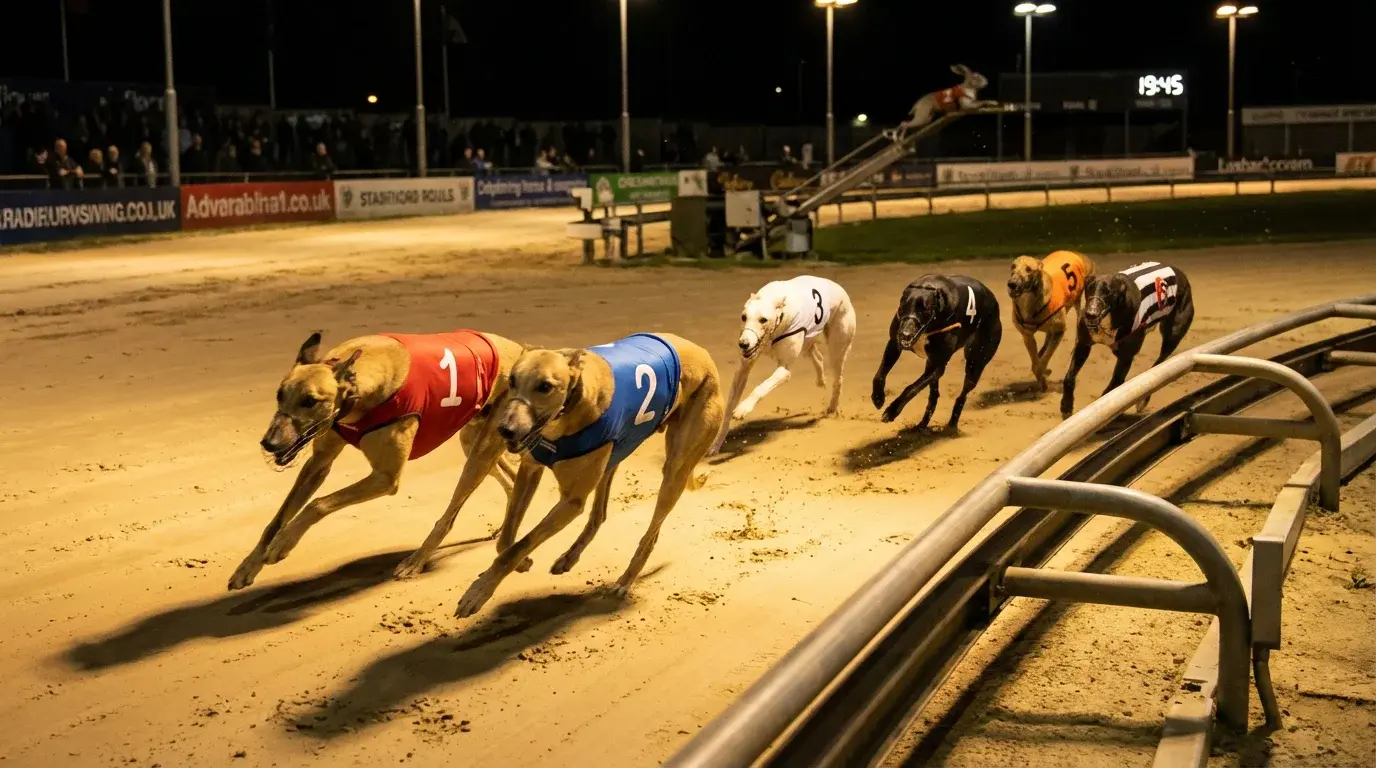
The UK greyhound betting market didn't shrink when GamStop arrived — it split. One side stayed within the regulated perimeter of UKGC-licensed operators, where self-exclusion requests are honoured automatically and account restrictions follow you across every platform in the network. The other side migrated offshore, towards bookmakers licensed in Curaçao, the Isle of Man or Malta, where GamStop's database has no jurisdiction and no technical reach. Neither side disappeared. Both kept growing, just in different directions and under very different rules.
That split is what this guide addresses. Not with a ranked list of bookmakers and a paragraph of marketing copy for each. Instead, this is a technical walkthrough of what greyhound betting outside GamStop actually involves: how platforms operate, what licensing means in practice, which bet types translate across regulatory borders, how to read form and trap data when your bookmaker doesn't provide built-in race cards, and which strategies hold up when the safety net of UKGC dispute resolution is no longer underneath you.
Greyhound racing occupies an unusual position in UK betting. It runs at pace — six dogs, sub-thirty-second races, dozens of meetings per day across tracks from Romford to Monmore. The sport generates steady turnover, yet it commands a fraction of the editorial and analytical attention that horse racing receives. That imbalance matters if you're betting offshore, because the thinner the public analysis, the greater the edge available to anyone willing to do the work themselves.
KEY FACT
Combined off-course, on-course and remote betting turnover on greyhound racing in Great Britain was estimated at £1.5 billion for the year ending March 2023, according to Gambling Commission industry statistics. Greyhound racing accounts for roughly 12% of betting shop yield nationwide — behind football and horse racing but well ahead of every other sport.
This guide is structured to serve two overlapping needs. If you already understand greyhound betting and want to know how the offshore landscape works — licensing verification, payment rails, bonus structures — those sections stand on their own. If you're a competent bettor looking to sharpen your greyhound-specific edge — form reading, trap draw analysis, sectional times, staking discipline — those sections go deeper than any competitor page currently offers. And if you need both, start at the top. Everything builds forward.
How GamStop Affects Greyhound Bettors in the UK
GamStop locks the front door but says nothing about the side entrances. That's not a design flaw — it's a jurisdictional boundary. The scheme was built to cover one specific territory: online gambling operators licensed by the UK Gambling Commission. Understanding exactly where that boundary runs, and why it exists, is the first step towards making informed decisions about betting outside it.
GamStop self-exclusion scheme — a free service operated by The National Online Self Exclusion Scheme Limited, which became mandatory for all UKGC-licensed remote gambling operators from 31 March 2020 (having soft-launched in April 2018). Registrants choose a minimum exclusion period of six months, one year or five years, during which all participating operators must block account access within 24 hours of a database update.
What GamStop Blocks and What It Doesn't
When you register with GamStop, your personal details — name, date of birth, email addresses, home address — are added to a centralised database. Every UKGC-licensed operator is required to cross-check that database at least once every 24 hours. If your details match, your account is frozen. You cannot log in, place bets, deposit or withdraw. This applies across desktop, mobile apps and telephone betting with any operator holding a Great Britain licence.

The scope is comprehensive within its jurisdiction. By the end of 2025, over 562,000 individuals had registered with the scheme, and GamStop recorded 58,675 new registrations in the second half of that year alone — an average of 319 per day. The system also works alongside software blocking tools such as Gamban, which prevents access to gambling websites at the device level, and the newly integrated GamStop Betting Shops scheme, formerly known as MOSES, which extends the concept to land-based premises.
What GamStop does not cover is any operator not holding a UKGC licence. Bookmakers licensed in Curaçao, Gibraltar, the Isle of Man or any other non-UK jurisdiction have no obligation to check the GamStop database, no technical integration with it, and no regulatory requirement to honour UK self-exclusion requests. This isn't a loophole — it's how jurisdictional licensing works. A Curaçao-licensed operator is regulated by Curaçao eGaming authorities. GamStop is a UK-specific tool, and its writ ends at the border of UK regulation.
Why Greyhound Punters Look for Non-UKGC Sites
The reasons vary, and not all of them relate to self-exclusion. Some bettors registered with GamStop during a moment of frustration or on impulse and later found that the rigid structure — no early cancellation, automatic seven-year renewal if you miss the end date — didn't match their actual needs. Others never registered with GamStop at all but prefer offshore operators for entirely different reasons: better odds on niche greyhound markets, access to international race meetings not covered by UK bookmakers, fewer restrictions on account limits and stake sizes, or the availability of cryptocurrency deposits.
Greyhound betting specifically suffers from a coverage gap on many UKGC platforms. While every major UK bookmaker offers horse racing with deep form data, live streaming and best-odds-guaranteed promotions, greyhound coverage is often minimal by comparison. Race cards are thinner, market depth is shallower, and promotional offers rarely extend beyond a token nod towards the dogs. For serious greyhound punters, this imbalance pushes them towards platforms — sometimes offshore ones — that treat the sport with the same analytical depth as racing's more glamorous sibling.
What Makes a Non-GamStop Greyhound Bookmaker Legitimate
A Curaçao licence number is a starting point, not a finish line. The offshore betting landscape includes everything from well-run operations with established track records to freshly launched sites that barely survive a year before vanishing with player funds. Distinguishing between the two requires more than checking whether a licence number appears on a homepage.
Licensing Authorities Beyond the UKGC
The most common licensing jurisdiction for non-GamStop bookmakers is Curaçao, specifically through the Curaçao eGaming authority (formerly operating under a single master licence, now transitioning to individual operator licences under the Curaçao Gaming Authority (CGA), which took on its current form following the National Ordinance on Games of Chance (LOK) enacted in December 2024). A Curaçao licence permits an operator to offer online gambling services globally, though it does not require the same level of player protection that the UKGC mandates. There is no mandatory self-exclusion integration, no affordability check requirement, and dispute resolution mechanisms are less formal.
Other jurisdictions you may encounter include the Isle of Man Gambling Supervision Commission, which operates a stricter regime closer to UKGC standards; the Malta Gaming Authority, which regulates a large portion of Europe's online gambling industry; and occasionally Anjouan or Kahnawake licences, which carry less regulatory weight. The jurisdiction matters because it determines what recourse you have if something goes wrong — a delayed withdrawal, a disputed bet settlement, or an account closure without explanation.
Verifying a Curaçao licence involves checking the licence number displayed on the operator's website against the records of the Curaçao Gaming Control Board. Legitimate operators will display their licence number in the site footer, often alongside a clickable seal that links to a verification page. If the seal doesn't link anywhere, or the licence number returns no results, treat that as the first red flag.
Red Flags That Signal an Unsafe Offshore Bookie
The absence of a visible licence is the most obvious warning sign, but it isn't the only one. Sites operating on white-label templates with identical layouts to dozens of other brands suggest a mass-produced operation with minimal investment in quality. Vague or missing terms and conditions — particularly around withdrawal limits and bonus wagering — indicate an operator that prefers ambiguity to accountability. A site without SSL encryption is transmitting your data in plain text. An operator with no listed contact email and no live chat has no intention of resolving disputes. Payment method availability matters too: legitimate offshore books support established e-wallets alongside crypto; a site accepting only obscure payment processors deserves scepticism.
Do
- Verify the licence number directly with the issuing authority's database
- Check for SSL encryption and secure payment gateways before depositing
- Read withdrawal terms and processing times in the full T&Cs, not the marketing summary
- Search for player reviews on independent forums — not testimonials hosted on the operator's own site
- Test customer support responsiveness with a pre-deposit enquiry
Don't
- Trust a licence seal that doesn't link to a verification page
- Deposit large amounts before testing a small withdrawal first
- Ignore vague bonus terms — if wagering requirements aren't clearly stated, they're designed to trap you
- Assume that a professional-looking website equals a professional operation
- Register with an operator that has no visible complaints or dispute resolution process
Greyhound Bet Types Available Outside GamStop
Six dogs, one trap each, and more betting angles than most punters realise. The compact field size in greyhound racing — always six runners, no exceptions at UK tracks — creates a different mathematical landscape from horse racing's variable fields of eight to forty. That fixed structure means forecast and tricast markets carry inherently different probability profiles, and understanding those profiles is what separates recreational punters from serious ones.
Most non-GamStop bookmakers offer the full range of greyhound bet types you'd find on a UKGC platform, though market depth can vary. The core markets — win, place, each-way, forecast, tricast and accumulators — are universal. Some offshore operators also offer speciality markets like trap challenge bets, match bets between individual dogs, and distance-specific handicap markets. The key difference is rarely in the type of bet available, but in the odds offered and the settlement rules applied.
Win, Place and Each-Way Bets
A win bet is exactly what it sounds like: you back a greyhound to finish first. A place bet backs a dog to finish in the first two (standard place terms for a six-runner greyhound race). Each-way is a combination of both — one stake on the win, one stake on the place — at standard terms of 1/4 odds for the place portion in a six-dog field.
The maths on each-way betting in greyhound racing differs from horse racing because the field size is fixed. In a six-runner race with two places paid at 1/4 odds, the place element carries meaningful value when you're backing a dog at longer prices. A 10/1 shot placed each-way returns 10/4 (2.5/1) on the place portion — a profitable outcome even without the win. At shorter prices, each-way value diminishes rapidly. A 2/1 favourite each-way returns just 1/2 on the place part, meaning you need the win to make the bet worthwhile.
Forecasts, Tricasts and Combination Bets
A straight forecast requires you to predict the first and second dog in the correct order. In a six-runner field, there are 30 possible first-second combinations (6 x 5), which gives a baseline probability of approximately 3.3% for any random selection. A reverse forecast covers both permutations of your two selections — either can finish first — at twice the stake.
Tricasts extend the principle to the first three finishers in exact order. The number of possible combinations jumps to 120 (6 x 5 x 4), making a straight tricast a roughly 0.83% probability event at random. A combination tricast covers all six permutations of your three selections, requiring six times the unit stake. The payouts on tricasts, particularly straight tricasts, can be substantial — returns of 100/1 to 500/1 are not uncommon in competitive open races, and on occasion they run into four figures.
Example: 480m Open Race — Romford
| Trap | Dog | Win Odds | Forecast (1st with Trap 3) | Tricast (1st-2nd-3rd with T3, T5) |
|---|---|---|---|---|
| 1 | Ballymac Dozer | 3/1 | 12/1 | 85/1 |
| 2 | Droopys Hawk | 7/2 | 14/1 | 95/1 |
| 3 | Signet Goofy | 5/2 | — | — |
| 4 | Priceless Jet | 6/1 | 22/1 | 180/1 |
| 5 | Crafty Doris | 8/1 | 28/1 | — |
| 6 | Romeo On Fire | 5/1 | 18/1 | 140/1 |

Accumulators and System Bets on Greyhounds
Accumulators — doubles, trebles, four-folds and beyond — work identically to any other sport: your selections must all win, and the returns compound across each leg. The difference with greyhound accumulators is the variance. Six-runner fields are inherently more unpredictable than larger fields because a single piece of interference at the first bend can eliminate the favourite. A four-fold greyhound accumulator with each selection at 3/1 offers a theoretical return of 255/1, but the probability of all four hitting is roughly 1.5% even before factoring in real-world disruption.
System bets — Lucky 15, Lucky 31, Patent, Yankee — provide coverage by including doubles, trebles and singles within a structured multi-bet framework. They're popular with greyhound bettors because the sport's volatility makes clean accumulators unreliable. A Lucky 15 on four selections costs 15 units but returns something as long as one dog wins. On non-GamStop platforms, check whether these system bet types are available before depositing — not all offshore bookmakers support them.
Reading Greyhound Form for Offshore Betting
A form line like '111243' tells a story — but only if you know how to read it. Each digit represents a finishing position in the dog's most recent races, read left to right from oldest to most recent. The sequence above describes a dog that won three consecutive races, then dropped to second, then fourth, then third. That's not a dog in decline — it's more likely a dog that was promoted in grade after those three wins and is now adjusting to tougher competition. The context behind the numbers matters as much as the numbers themselves.
When you're betting offshore, the form data available to you may be less polished than what UK platforms present. Some non-GamStop bookmakers provide basic race cards; others offer nothing beyond a dog's name and trap number. This makes independent form analysis an essential skill rather than a luxury. Sites like the Greyhound Board of Great Britain's results service, timeform.com for ratings, and Sporting Life's greyhound section provide the raw material you need — trap draws, finishing positions, sectional times, trainer details and grade histories — regardless of where you place your bets.

Improving Dog
Form: 543211 — Steady progression from mid-pack to consecutive wins. Likely recently promoted in grade. Watch for whether the improvement holds at the new level.
Declining Dog
Form: 112345 — Early wins followed by sliding positions. Could indicate fitness issues, grade too high, or loss of early pace. Check for recent distance or track changes.
Inconsistent Dog
Form: 314152 — Wins mixed with poor runs. Often a dog affected by trap draw or track shape. Strong in certain conditions, unreliable in others. Study trap and distance data closely.
Sectional Times and What They Reveal
Sectional times measure how quickly a dog covers specific portions of a race — typically the run to the first bend, the time from first bend to the back straight, and the finishing section. They reveal running style more accurately than finishing position alone. A dog that posts a fast first-section time but fades in the final split is an early-pace runner — valuable in certain race shapes, vulnerable in others. A dog with a moderate opening split but a strong finishing section is a closer, the kind that picks off tiring leaders.
Comparing sectional times across tracks requires caution. A 16.80-second 270-metre split at Romford doesn't translate directly to a 16.80 at Towcester because track geometry, surface condition and camber angles differ. What you can compare is relative performance: how does a dog's first-section time at a given track measure against the average for that grade and distance? If it's consistently 0.15 seconds faster than the field average, you're looking at a dog with a genuine early-speed advantage at that venue, which directly informs trap draw analysis and race prediction.
Grade, Distance and Going Preferences
UK greyhound racing uses a grading system from A1 (top grade at a given track) through A2, A3 and down to A11 at some venues. A dog winning consistently at A4 will be promoted to A3, where it faces faster competition. The transition period after promotion is where value often lies — the market may price a newly promoted dog as if it's outclassed, when in reality its form line simply reflects one or two runs against stronger opponents.
Distance preference is less variable in greyhounds than in horse racing but still significant. Most UK track meetings are run over standard distances — 265m sprints, 480m middle-distance, 640m+ stayers — and individual dogs have clear preferences. A dog with a string of sprint wins suddenly entered over 480m deserves scrutiny: can it sustain pace, or will it fade after the second bend? The form figures alone won't answer this, but sectional times and previous runs at longer distances will.
Going conditions affect greyhound performance more than casual bettors appreciate. A wet track at an outdoor venue like Romford slows times and favours strong, powerful runners over lighter, faster dogs. A dry, fast track at a sheltered all-weather venue produces times closer to the dog's peak ability. Noting whether a dog's best form comes on a particular going is a detail that many offshore bettors overlook — and precisely why it offers an edge.
Trap Draw and Track Bias in Greyhound Betting
Trap 1 has a statistical edge at most UK tracks — but statistics alone don't cash bets. The inside trap advantage is real: across the majority of UK circuits, trap 1 produces a higher win percentage than any other trap over large sample sizes. At some tracks that advantage is marginal. At tight-turning tracks with short runs to the first bend, it's significant enough to shift the odds.
The reason is mechanical. Trap 1 offers the shortest path to the rail on the first bend, and the rail is the fastest route around a greyhound track. A dog drawn in trap 1 that shows even moderate early pace can secure the inside line before the field converges, avoiding the crowding and interference that frequently disrupts mid-pack runners. Trap 6, by contrast, has the widest route to navigate and is most exposed to trouble from dogs cutting across. At wider, more galloping tracks — Towcester's old circuit was a classic example — the outside trap disadvantage diminishes because there's more room for dogs to find their stride before the first turn.
Track-specific data is essential because national averages mask enormous local variation. At Romford, for instance, trap 1 has historically produced win rates above 20% over standard 400m distances, while trap 6 sits closer to 13%. At Monmore, the distribution is flatter — the track's wider bends reduce the inside advantage. At Hove, the camber and bend geometry create pockets of bias at certain distances that don't follow the standard 1-through-6 gradient at all.
Where trap draw analysis becomes genuinely useful is at the intersection with a dog's running style. A confirmed railer — a dog that naturally seeks the inside line — drawn in trap 1 is the ideal combination. The same dog drawn in trap 6 faces a problem: it wants to cross the field to reach the rail, and that movement creates interference risk for both itself and the dogs around it. A wide runner drawn in trap 6, on the other hand, can run its natural race without needing to adjust, which is why some experienced punters specifically look for wide runners drawn outside.
IMPORTANT
Trap statistics are population averages — they describe what happens over thousands of races with thousands of different dogs. They do not predict what will happen in a single race with a specific six-dog field. A confirmed wide runner with strong recent form drawn in trap 6 is a better bet than a moderate railer with declining form drawn in trap 1. Always let individual dog form override blanket trap bias. Use trap data as a tiebreaker, not a foundation.
For practical betting purposes, trap draw data is most valuable when combined with sectional time analysis. A dog with proven early pace drawn in trap 1 or 2 is the profile most likely to lead through the first bend uncontested. A dog with a strong finishing section drawn in trap 5 or 6 is the profile most likely to be caught in traffic early but finish powerfully if it gets a clear run. Matching running style to trap position to track geometry is where form analysis becomes race prediction — and it's a level of detail that the vast majority of greyhound bettors simply don't reach.
Understanding form, traps and track bias gives you the raw material. What follows is what you do with it.
Greyhound Betting Strategies That Work on Non-GamStop Sites
Strategy without discipline is just an opinion with a staking plan. The three approaches outlined here are not theoretical frameworks — they're methods used by profitable greyhound bettors, each suited to different risk tolerances and market conditions. All three work on non-GamStop platforms, though each requires access to certain features: value betting needs reliable odds comparison, Dutching needs a platform that accepts multiple selections per race, and exchange laying requires a betting exchange (most commonly Betfair, which is UKGC-licensed, though some offshore exchanges exist).
Value Betting
Risk: Medium
Best for: Patient bettors with strong form analysis skills who can maintain discipline over hundreds of bets. Requires accurate probability assessment and long-term tracking.
Dutching
Risk: Low to Medium
Best for: Bettors who can narrow a six-dog field to two or three genuine contenders. Works best in open races where the market is competitive and no single dog dominates.
Laying the Third Favourite
Risk: Medium to High
Best for: Exchange users who understand liability management. Exploits the tendency of third favourites in greyhound racing to underperform their market position.

Value Betting on Greyhound Odds
Value betting is the foundation of every profitable long-term approach. The concept is straightforward: if you assess a dog's true probability of winning as higher than the probability implied by the bookmaker's odds, the bet has positive expected value. Over a large enough sample, positive expected value bets generate profit regardless of short-term variance.
In practice, finding value in greyhound markets requires your own probability assessment — derived from form, trap draw, sectional times and going conditions — and a method for converting that assessment into a percentage. If you estimate a dog's chance at 30%, the fair odds are approximately 10/3 (4.33 decimal). If the bookmaker offers 5/1, there is value. If they offer 2/1, there isn't, and the correct play is to pass the race.
Greyhound markets on non-GamStop sites are frequently less efficient than their UKGC equivalents, partly because offshore books set greyhound odds with less granular form data and partly because wagering volume is lower. Lower liquidity means prices are set by the operator's model rather than the weight of public money, which creates pockets of exploitable value for anyone with better information.
Dutching Across Multiple Traps
Dutching is the practice of backing more than one dog in a race, with stakes calculated so that you make the same profit regardless of which selection wins. It's not hedging — it's arithmetic. In a six-runner greyhound race, if your analysis eliminates three dogs as genuine non-contenders, backing the remaining three at correctly proportioned stakes can deliver consistent returns.
The calculation is simple. Convert each selection's odds to implied probability, sum those probabilities, and if the total is below 100%, a profitable Dutch exists. For example: Dog A at 3/1 (25% implied), Dog B at 4/1 (20% implied), Dog C at 5/1 (16.7% implied). Combined implied probability: 61.7%. Since this is well below 100%, the Dutch is profitable. Your stake on each dog is proportioned inversely to the odds, equalising the profit across all three outcomes.
The risk is that one of the three remaining dogs — the ones you eliminated — wins. Dutching doesn't reduce the probability of losing; it redistributes your stake to improve returns when your analysis is correct. In greyhound racing, where the small field size means your eliminated dogs are often genuine outsiders, Dutching can be particularly effective in open graded races where form separates the field clearly.
Laying the Third Favourite on Exchanges
Laying a dog means betting that it will not win — you take the role of the bookmaker. On a betting exchange, you offer odds to backers and collect their stake if the dog loses. Your risk is the payout if the dog wins, known as your liability.
The third favourite in greyhound racing occupies an awkward market position. It's priced short enough that backers find it tempting — typically between 4/1 and 7/1 — but long enough that it needs everything to fall right to win. It's often a dog with decent form but a poor trap draw, or a dog promoted in grade that hasn't yet proven itself at the new level. Laying the third favourite in races where your form analysis supports the front two in the market, and where the third favourite faces a specific obstacle (bad trap, wide runner drawn inside, distance change), targets the market's tendency to compress odds towards mid-range runners.
This strategy demands strict entry criteria. Not every race qualifies. You need a clear front two in the market, a third favourite with an identifiable weakness, and exchange liquidity sufficient to place the lay at a price that makes sense after commission. Staking should be proportioned so that your liability on any single lay never exceeds 3-5% of your exchange bankroll. Discipline in selection — skipping races that don't fit the criteria — is what separates a strategy from gambling on a theory.
Live Betting and Streaming on Non-GamStop Greyhound Sites
In-play greyhound markets move faster than most punters can react — that's the point. A greyhound race lasts under thirty seconds from trap to finish. The in-play window, where odds are adjusting in real time, is measured in fractions of that. Unlike football or tennis, where in-play betting unfolds over hours, greyhound in-play is a compressed, high-intensity market that rewards preparation far more than reaction speed.
The practical reality is that very few bettors place in-play bets on greyhound races in the traditional sense of watching the race and clicking during it. What in-play markets actually serve is a slightly different function: they allow you to assess the pre-race market movement — how odds shift in the final seconds before traps open — and to place late bets that capture information not reflected in the morning prices. A significant move on a dog in the final minute before a race can indicate money from informed sources, and that signal has value whether you bet pre-race or in the in-play window.
Live streaming is what makes any of this possible. Several non-GamStop bookmakers offer live streams of UK and Irish greyhound meetings, typically sourced from SIS (Sports Information Services) and RPGTV feeds. Coverage varies: some offshore platforms stream every BAGS meeting alongside evening cards, while others offer selective coverage. Before committing to a platform, verify its streaming schedule against your preferred tracks. A bookmaker covering twelve UK tracks daily is functionally different from one streaming three.
What to look for in a live betting interface is speed and simplicity. A platform that requires three clicks to place a bet during a thirty-second race is a platform not designed for greyhound in-play. The best interfaces show a live odds ladder, a one-click bet placement option, and a cash-out button that doesn't lag behind the market. Not every offshore bookmaker meets this standard, and testing the interface with small stakes before committing larger sums is a basic due diligence step that too many bettors skip.
Payment Methods for Offshore Greyhound Betting
Your deposit method determines withdrawal speed — choose accordingly. This sounds like obvious advice until you discover that the Visa debit card you used to deposit can't be used for withdrawals at your chosen offshore bookmaker, and the only alternative is a bank wire transfer that takes five to seven business days and carries a processing fee. Payment method selection on non-GamStop platforms requires more thought than it does on UKGC sites, where regulators mandate specific consumer protections around deposits and withdrawals.
Debit and credit cards (Visa and Mastercard) are accepted by most offshore bookmakers, but card withdrawals are often restricted or unavailable. Some banks and card issuers actively block transactions to non-UKGC gambling sites, which means your deposit may be declined even if the bookmaker accepts the card type. This is not a GamStop-related block — it's the bank's own anti-fraud or gambling transaction policy.
E-wallets offer the most practical balance of speed and accessibility. Skrill, Neteller and MiFinity are the three most commonly available at non-GamStop bookmakers. Deposits are instant, and withdrawals typically process within 24 to 48 hours once approved by the operator. The trade-off is fees: both Skrill and Neteller charge for certain transactions, and currency conversion fees can accumulate if the bookmaker operates in a different base currency. Setting up the e-wallet in GBP and choosing bookmakers that accept GBP deposits avoids the worst of these charges.
Cryptocurrency — primarily Bitcoin, Ethereum and USDT (Tether) — is the fastest-growing deposit method on offshore platforms. Crypto deposits are typically processed within minutes, carry no third-party fees beyond network gas costs, and are not subject to bank-level gambling blocks. Withdrawals in crypto are equally fast once approved. The downside is volatility: if you deposit Bitcoin and the price drops 5% before you withdraw, your effective balance has decreased regardless of your betting results. Stablecoins like USDT eliminate this risk, which is why they've become the preferred crypto option for bettors who want the speed of blockchain without the exposure to price swings.
Bank wire transfers remain available as a fallback but are the slowest option. Processing times of three to seven business days are standard, and fees of £15-£25 per transfer are common. For bettors who deposit infrequently and withdraw large sums, the fee is proportionally trivial. For anyone on a regular deposit-withdraw cycle, wires are impractical.
Match your deposit method to your expected withdrawal frequency. If you plan to withdraw weekly, use an e-wallet or crypto. If you deposit once and withdraw once a month, bank transfers are tolerable. Whatever you choose, test a small withdrawal before committing significant funds — processing time and fee claims are only trustworthy once verified firsthand.
Bonuses and Free Bets on Greyhound Sites Not on GamStop
A 150% deposit bonus means nothing if the wagering terms are engineered against you. Non-GamStop bookmakers compete aggressively on bonus offers precisely because they operate outside the UKGC's advertising restrictions, which means larger headline numbers, more creative structures, and — inevitably — more aggressive wagering requirements designed to make the bonus difficult to convert into withdrawable cash.
The standard bonus structure at offshore greyhound sites is a deposit match: deposit £100, receive £150 in bonus funds (a 150% match), or deposit £50 and receive £50 (a 100% match). The critical variable is the wagering requirement — the number of times you must bet through the bonus amount before it becomes withdrawable. A 30x wagering requirement on a £100 bonus means you must place £3,000 in total bets before the bonus balance converts to real money. At an average return rate, the mathematical expectation is that most of the bonus will be lost before the requirement is met.
Greyhound-specific restrictions add another layer. Some offshore bookmakers exclude greyhound betting from bonus wagering entirely, or count it at a reduced rate — 50% contribution is common, meaning every £1 wagered on greyhounds counts as only 50p towards the requirement. Others impose minimum odds conditions: bets at odds below 1.50 (1/2) or even 2.00 (evens) may not contribute at all. If your greyhound betting style involves short-priced selections — backing favourites, place-only bets, or low-odds legs in system bets — the bonus may be functionally useless regardless of the headline figure.
Free bets are generally more transparent but come with their own conditions. A typical offer credits your account with a fixed amount after you place a qualifying bet at minimum odds (commonly evens or above). The free bet itself typically returns only the profit, not the stake, and must be used within a specified window — seven days is standard, though some operators give as little as 48 hours.
Evaluating genuine value requires reading the full terms and conditions, not the promotional banner. Calculate the effective value of any bonus by working through the wagering requirement at a realistic return rate. If the expected loss through wagering exceeds the bonus amount, the offer has negative value — you're better off depositing and betting without it. This calculation takes two minutes and will save you from chasing a bonus through hundreds of pounds of forced betting.
Responsible Betting Outside GamStop
Leaving GamStop's perimeter doesn't mean leaving discipline at the door. If anything, betting on non-GamStop platforms demands more personal responsibility, not less. The structures that UKGC-licensed operators are required to provide — deposit limits, reality checks, cooling-off periods, automated affordability flags — do not exist on most offshore sites, or exist only as optional features that the bettor must actively seek out and configure. The safety net is gone. What replaces it is you.
Self-imposed limits are the most effective tool available, and they require honesty more than willpower. Set a daily, weekly and monthly deposit limit before you begin — not a vague intention, but a specific number written down or entered into whatever tracking system you use. Track every bet: date, race, selection, stake, odds, result. This isn't admin for the sake of it; it's the only way to know whether your actual results match your expectations, and it's the fastest way to identify when your betting behaviour is shifting from controlled to compulsive.

Third-party blocking software can replicate some of the protections that GamStop provides. Gamban blocks access to gambling websites at the device level — it works across browsers, apps and VPNs on Windows, Mac, iOS and Android. BetBlocker offers a similar service with configurable block durations. Neither tool is mandatory on offshore platforms, but both are free and both work independently of any specific bookmaker's cooperation. If you're using non-GamStop sites and want a technical barrier against impulsive access during vulnerable moments, these tools are available and effective.
Recognising the early signs of problematic gambling is easier in theory than in practice. Chasing losses, betting more than intended, hiding activity from others, borrowing to fund bets — these warning signs are well documented but often emerge gradually. Self-assessment is unreliable when you're inside the pattern. An external check — a trusted person who knows you bet, a gambling diary that forces you to confront your expenditure — provides the objectivity that internal reflection alone cannot.
SUPPORT RESOURCES
If gambling is causing you financial, emotional or relational harm, help is available regardless of whether you bet on UKGC or offshore platforms. BeGambleAware provides information, advice and free counselling referrals. The GamCare helpline (0808 8020 133) offers confidential support 24 hours a day, seven days a week. Both services are free, confidential and available to anyone in the UK.
The broader point is this: GamStop was designed as a tool for people who have identified a problem and want a blanket block. Betting outside that block, for whatever reason, means taking full ownership of your gambling behaviour. That ownership includes knowing when to stop — not just for the session, but entirely. No guide, no strategy, and no bookmaker edge is worth pursuing if the cost is your financial stability or wellbeing.
FAQ
Are non-GamStop greyhound betting sites legal for UK punters?
There is no UK law that makes it illegal for an individual to place bets with an offshore bookmaker. GamStop is a self-exclusion scheme administered by UKGC-licensed operators — it does not extend to operators licensed in other jurisdictions such as Curaçao, Malta or the Isle of Man. However, these operators are not regulated by the UKGC, which means UK-specific consumer protections — including mandatory dispute resolution, affordability checks and advertising standards — do not apply. The legal responsibility for choosing where to bet rests with the individual, and the reduced regulatory oversight means accepting a higher degree of personal risk.
How do I verify that an offshore greyhound bookmaker is safe?
Start with the licence. Every legitimate offshore bookmaker displays a licence number — typically from Curaçao eGaming, the Malta Gaming Authority or the Isle of Man Gambling Supervision Commission. Verify that number directly with the issuing authority's public register. Beyond the licence, check for SSL encryption, transparent terms and conditions (especially withdrawal limits and processing times), multiple established payment methods, and accessible customer support. Test a small deposit and withdrawal cycle before committing significant funds. Search for player reviews on independent forums rather than relying on testimonials published on the operator's own site.
What greyhound bet types can I place on sites outside GamStop?
Most non-GamStop bookmakers offer the full range of greyhound betting markets: win, place, each-way, straight and reverse forecasts, straight and combination tricasts, and accumulators including doubles, trebles and system bets like Lucky 15 and Lucky 31. Some offshore platforms also provide speciality markets such as trap challenge bets and match bets between individual dogs. Market depth varies by operator — larger offshore books typically cover all BAGS and evening meetings at UK tracks, while smaller operators may offer limited race cards. Verify the available markets before depositing.
The Sixth Trap — Where Smart Greyhound Betting Really Starts
Most guides end with a list of bookmakers. This one ends with a principle.
There are six traps in a greyhound race, and every one of them is occupied by a dog that has been trained, graded, drawn and prepared for the thirty seconds ahead. The form has been studied. The odds have been set. The market has spoken. But none of that accounts for the bettor's own decision-making — the invisible seventh variable that no race card includes and no bookmaker prices in.
Call it the sixth trap if the metaphor fits better: the position you occupy when you decide to bet, how much, and on what terms. Everything in this guide — the form analysis, the trap draw data, the sectional times, the strategy frameworks, the licensing checks, the payment method comparisons — is raw material. It has no value sitting in your head as knowledge. It generates value only when it's applied with discipline, tracked with honesty, and abandoned when the evidence says it isn't working.
Greyhound betting outside GamStop is not inherently riskier or more profitable than betting within it. The races are the same. The dogs are the same. The maths is the same. What changes is the infrastructure around you: fewer automatic safeguards, less regulatory recourse, more personal responsibility for every decision from platform selection to stake sizing to knowing when to walk away. That isn't a disadvantage for a prepared bettor — it's a neutral fact that rewards preparation and punishes laziness in equal measure.
The 2026 greyhound racing calendar is marking a centenary year for the sport in the UK, with the GBGB scheduling 50 category one competitions and 27 category twos across English and Welsh tracks. The Greyhound Derby, running from late April to early June at Towcester, remains the sport's flagship event and one of its most heavily bet races. The season ahead is dense with opportunity. Whether you exploit it or donate to it depends entirely on what you bring to the sixth trap.
