Best Greyhound Betting Sites – Bet on Greyhounds in 2026
Loading...
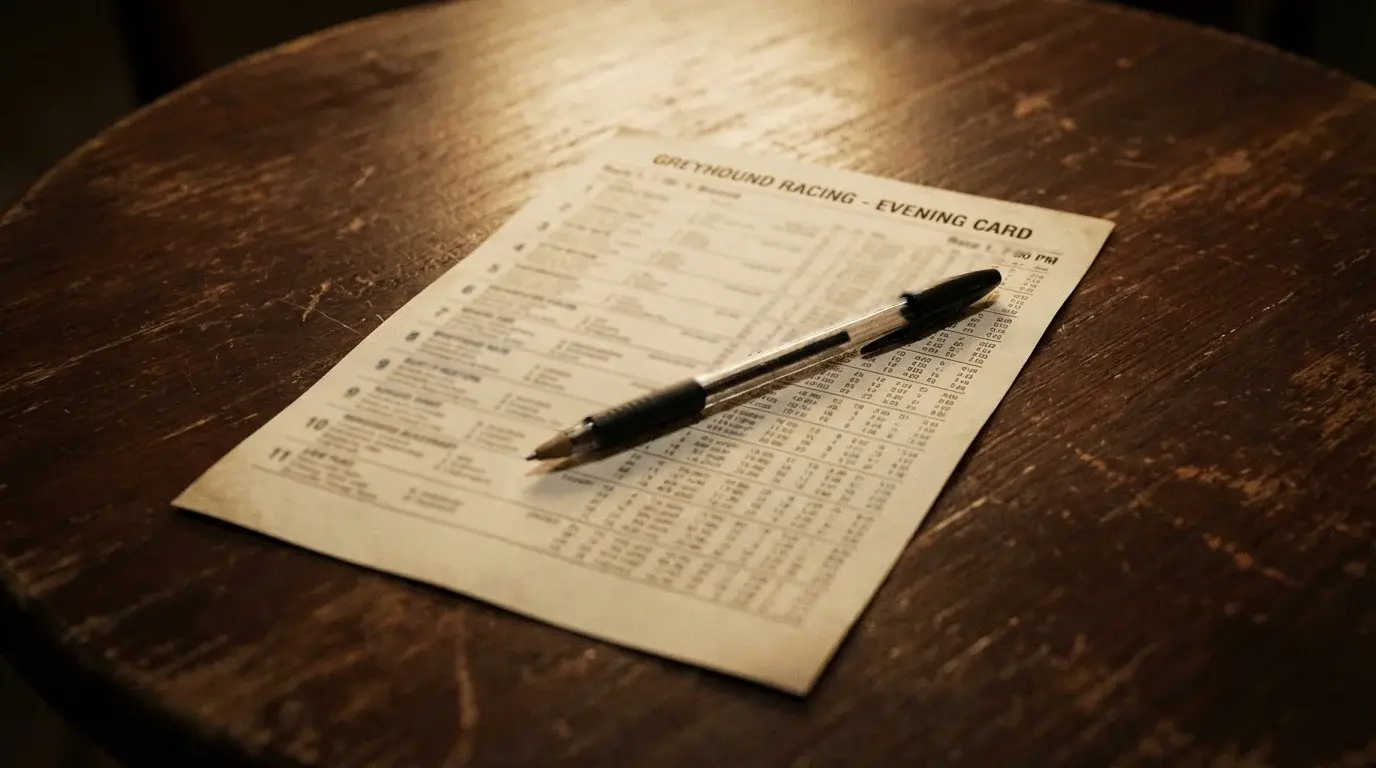
Every number on a race card is a clue — if you know what it means. The problem is that most greyhound race cards look like compressed spreadsheets designed by someone who assumed every reader already understood the format. Trap numbers, form strings, sectional splits, weight readings, trainer codes and grade indicators are all crammed into a few lines per dog. For a seasoned punter at Romford on a Tuesday evening, that density is efficient. For anyone approaching greyhound betting with even a small gap in knowledge, it is a wall.
This guide strips the race card back to its individual components, walks through each data point in the order it appears, and flags where the card alone does not give you enough to make a decision. A race card is a starting point — your pre-race briefing, not your final answer. But if you cannot read the briefing properly, everything that follows — form analysis, trap bias evaluation, staking decisions — starts on unstable ground. The examples here are drawn from standard UK race card formats used across BAGS and RPGTV meetings, which offshore bookmakers covering British greyhound racing typically reproduce directly.
Anatomy of a Greyhound Race Card
A standard UK greyhound race card presents information for each of the six runners in a single race. The layout varies slightly between providers — Racing Post, Timeform, SIS and individual track cards each have their own formatting quirks — but the core data points remain consistent. Here is what you will see, in the approximate order it appears.
Trap number and colour. Each dog is assigned a trap from 1 to 6, colour-coded by a universal system: red (1), blue (2), white (3), black (4), orange (5), black and white stripes (6). The jacket colours match the trap assignments, so when you watch a race — live or streamed — you can immediately identify which dog is which. Trap assignment is not random. It is decided by the racing manager based on a dog’s running style and the need to produce competitive races. Alongside the trap, you will see the dog’s registered name, sex (d for dog, b for bitch), colour and breeding information.
Trainer. The trainer name is listed alongside each runner. Trainer form — their recent win percentage across all runners, not just the dog in question — can be a meaningful supplementary indicator. Some trainers consistently produce runners that are sharp and race-ready. Others have patterns of bringing dogs to peak fitness for specific events. The card gives you the name; the analysis requires external data.
Weight. The dog’s racing weight is recorded in kilograms, often with a note of change from the last run. Significant weight gain (more than 1 kg) can indicate a dog that is not in peak condition. Weight loss beyond 0.5 kg might signal hard training — or a health issue. Small fluctuations of a few hundred grams are normal and rarely meaningful.
Form figures. This is the most information-dense element on the card and gets its own section below. The form string is a sequence of finishing positions from recent races, typically the last five or six runs, read from left to right with the most recent on the right. Numbers 1 through 6 indicate finishing position. Letters encode additional information: m (middle runner), w (wide runner), and various codes for falls, baulking and non-finishes.
Sectional times. On many UK race cards, you will see a split time recorded for each dog — usually the time to reach the first bend and the overall finishing time. Sectional data reveals how a dog runs: a fast first split means early pace; a faster second half suggests a closer. Comparing sectional times across different races requires adjusting for track distance and conditions, but at the same circuit, direct comparison is straightforward.
Grade and class. The race grade (A1 through A11 in the standard UK system, plus open races) tells you the calibre of competition. A dog recently dropped from A3 to A5 is meeting weaker rivals — which may look like poor form but could represent an opportunity. The card states the grade; interpreting it requires context about how the grading system works.
Distance. Greyhound races in the UK range from roughly 210 metres (sprint) to over 900 metres (marathon). The card specifies the distance for the race, and each dog’s record typically indicates which distances it has run previously. A sprinter entered in a 480m race and a stayer entered in a 265m dash are both likely to underperform — the card tells you this, provided you check.
How to Interpret Form Figures
The form string is where most of the actionable intelligence sits, and it is also where most beginners misread the data. A sequence like 321142 looks straightforward — the dog finished third, second, first, first, fourth, second in its last six races. But the raw numbers only tell part of the story. The context behind each digit matters far more than the digit itself.
Start with direction. Is the form improving, deteriorating or flat? A string reading 543211 shows a dog that has been climbing steadily through its recent outings — a clear progression that suggests the trainer has it in good shape and it may still be improving. Contrast that with 112345, which signals the opposite trajectory: a dog that was sharp a few runs ago but is now losing ground. The most recent figures (rightmost) carry more weight than older ones, but the trend line across all six gives you momentum — or the lack of it.
Next, read the letters. Not all race cards include running-style annotations, but many UK cards use shorthand to describe how a dog ran. The most common codes are: m (ran in the middle of the track), w (ran wide), rls (raced on the rails), crd (crowded or checked during the race), bmp (bumped), fl (fell), and ht (hampered by trouble). A form figure of 4 does not mean the same thing when paired with “crd” as it does when the dog ran a clean race. A dog that finished fourth after being badly crowded on the first bend may have run considerably better than the number suggests.
This is where the race card rewards careful reading. A superficially poor form line can conceal a dog that has been unlucky — repeatedly drawn in awkward traps, hitting traffic at the first bend, or meeting above-average opposition in graded races it was promoted into too quickly. Conversely, a dog showing 111 might have been beating weak fields in lower grades and could struggle when the competition stiffens.
One specific pattern to watch for is the returning runner. A dash (–) or letter code (R for rest, T for trial) in the form string indicates a break from racing. Dogs returning from layoffs are unpredictable. Sometimes they come back sharper after recovery. Often they need a run or two to regain full race fitness. A dog showing a form line like 11–432 had a break between its early wins and recent efforts — the poor numbers after the gap may reflect ring rust rather than declining ability.
Finally, consider the weight trend alongside form. If a dog’s form has deteriorated and its weight has increased by a kilogram or more, the picture becomes clearer: the dog is likely not in peak condition. But if form has dipped while weight is stable, look at the running comments and race conditions instead — the explanation probably lies in traffic trouble, adverse draws or unsuitable track conditions rather than fitness.
Spotting Opportunities in a Race Card
Reading a race card accurately is a necessary skill. Extracting betting value from it is the next level. The card contains several patterns that consistently produce opportunities — situations where the market is likely to underprice or overprice a dog based on how most punters interpret the raw data.
The grade dropper. When a dog has been competing in a higher grade and is dropped down — say from A3 to A5 — its recent form might show a string of fourths and fifths. On paper, that looks poor. In reality, the dog was being beaten by faster opposition. Now it faces slower dogs, and those sectional times that were mid-pack in A3 might put it at the front of an A5 field. The race card tells you the grade of both the current race and the dog’s recent outings. If there is a visible drop, check whether the dog’s times are competitive for the lower grade. This is one of the most reliable angles in greyhound betting, and the card gives you everything you need to identify it.
The trap-form match. A dog with a clear rails-running style (evidenced by “rls” annotations or consistently strong form from traps 1 and 2) drawn in trap 1 today is in its preferred position. The reverse also holds — a wide runner in trap 6 has room to operate. When a dog’s trap assignment aligns with its natural running style, you should expect it to perform closer to its ceiling. When there is a mismatch — a railer drawn in trap 5, for example — expect underperformance regardless of how strong the recent form looks. The card shows both the current trap and the traps from previous runs. Cross-referencing these takes ten seconds and regularly reveals mispriced selections.
The time advantage. Sectional times vary between tracks, so direct comparisons only work within the same venue. But when two dogs in the same race have recent runs at the same track over the same distance, their finishing times are directly comparable. A dog clocking 29.50 seconds over 480m at Romford is faster than one posting 29.85 at the same distance and venue. If the quicker dog is not the favourite, the card is handing you a potential value bet.
The trouble indicator. Look for dogs that finished poorly but have annotations showing interference. A fifth-place finish with “crd, bmp 1” (crowded and bumped at the first bend) is not the same as a clean fifth. If the dog ran cleanly in its previous outings and finished much higher, the poor run is likely an outlier caused by race-day traffic rather than declining ability. The market often overreacts to a single bad result, creating value for anyone who reads the comments column carefully.
Trainer patterns at specific meetings. Some trainers have higher strike rates at certain tracks. The card lists the trainer name — the pattern recognition has to come from your own records or external databases. If you notice the same trainer name appearing multiple times at a particular meeting with dogs in favourable traps, it is worth investigating. Trainers know their dogs, and they choose which meetings to enter them in for a reason.
None of these patterns guarantee a winner. But they consistently narrow the field of realistic contenders and highlight where the market is most likely to have made an error. The race card provides the raw material. Your job is to recognise the patterns and act on them before the odds adjust.
Your First 30 Seconds With Any Race Card
You do not need to memorise every data point before a race. What you need is a triage process — a way to scan the card quickly and decide whether a race contains enough readable information to justify a bet, or whether you should skip it entirely.
In your first ten seconds, look at the form strings for all six dogs. Are there any obvious improvers (descending numbers toward the right)? Any steep decliners? Does one dog have a clearly superior recent finishing record compared to the rest of the field? If no dog stands out on raw form, the race may be a competitive puzzle that requires deeper analysis — or it may be one to leave alone.
In the next ten seconds, check trap draws against running styles. If the card shows running-style annotations, identify any strong trap-style matches or mismatches. A railer in trap 1 with good recent form is already interesting. A wide runner boxed in trap 2 with traffic-heavy dogs inside and outside is a warning sign.
In the final ten seconds, look at grade context and sectional times. Has anyone been dropped in grade? Does one dog have a clear time advantage over the field at this distance and venue? Is there a returning runner whose recent trial time was competitive?
Thirty seconds. Six dogs. Three passes. That is all it takes to decide whether a race card is giving you a clear enough picture to make a decision. The detailed analysis — weight trends, trainer patterns, going adjustments — comes after this initial scan, and only for races that survived the first filter. Most race cards will not produce a confident bet. That is the point. The card is not there to make every race look attractive. It is there to help you find the ones worth your attention and your money — and ignore the rest.