Best Greyhound Betting Sites – Bet on Greyhounds in 2026
Loading...
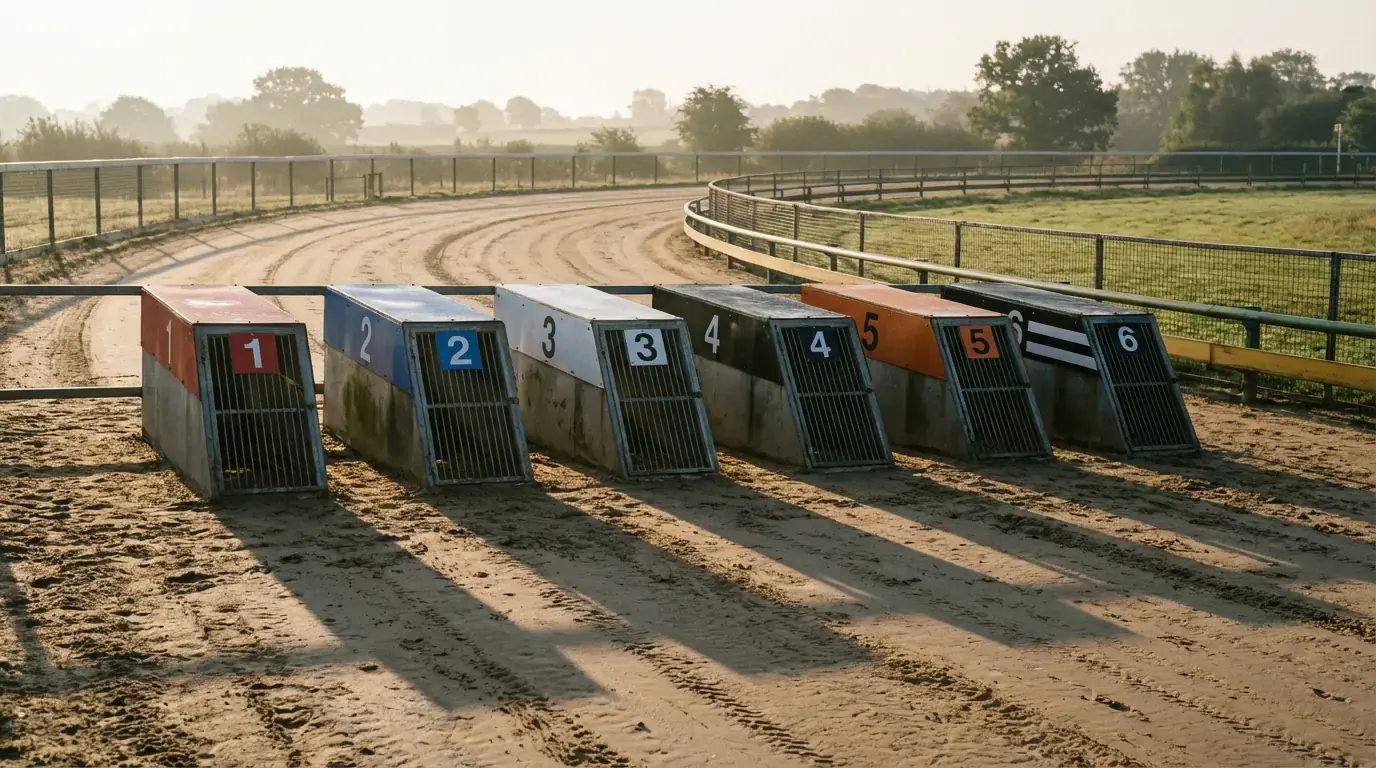
Trap 1 wins more often than trap 6 — at most tracks. The devil is in “most.” Aggregate data across the entire UK greyhound circuit shows a mild statistical advantage for inside traps, which makes intuitive sense: trap 1 has the shortest path to the first bend and only one neighbouring dog to worry about. But averages flatten the picture. Individual tracks produce meaningfully different trap biases, and those differences shift from season to season as surfaces are maintained, rails are repositioned and race schedules change.
Treating trap statistics as a universal betting edge is a common beginner error. Treating them as irrelevant is an experienced punter’s blind spot. The truth is somewhere in between: trap data is a filter, not a selection method. It narrows the field and adjusts expectations. It does not, by itself, pick winners. What follows is a breakdown of how trap statistics work across UK greyhound tracks, what causes the biases, and how to integrate the data into decisions that actually improve your strike rate.
UK Trap Win Percentages by Track
Winning percentages for each trap are published annually and updated throughout the season by data services covering UK greyhound racing. Across all registered tracks in a typical year, the distribution looks roughly even — each trap wins between 15% and 18% of races, with trap 1 usually sitting at or near the top of the range and traps 3 and 4 clustered slightly below average. The overall spread is narrow enough that no single trap offers a reliable blanket betting angle.
The picture changes dramatically when you break the numbers down by individual venue. At Towcester, trap 1 has historically registered around a 20% strike rate in graded races — a substantial outlier that reflects the track’s tight first bend and short run-in from the boxes. Dogs on the rail have a genuine geometric advantage there, and the data confirms it year after year. At the other end of the spectrum, Harlow has produced a notable 21% strike rate for trap 6 in certain seasons, driven by a wider first bend that gives outside runners room to stride out without interference.
Nottingham, which hosted the English Greyhound Derby in 2019 and 2020 before the event returned to Towcester in 2021, tends to produce a more balanced trap distribution. The track’s configuration — longer straights and smoother bends — reduces the positional advantage that tighter circuits generate. Similarly, Romford’s compact oval means early speed matters more than trap position, and the data there shows less trap bias and more dependence on individual sectional pace.
The key point is that blanket statistics like “trap 1 wins the most” are technically accurate but practically useless unless you know which track you are looking at. A bettor who backs trap 1 dogs indiscriminately across all UK venues is running a losing strategy — the edge at Towcester is offset by average or below-average performance elsewhere. But a bettor who knows that trap 1 at Towcester outperforms by three to four percentage points has a genuine informational advantage over the market.
One further layer of granularity worth tracking: trap statistics for open races versus graded races. Open races attract the highest-quality dogs, and these runners tend to be more versatile — capable of overcoming a disadvantageous draw through raw speed and tactical ability. In graded races, where the talent pool is more evenly matched, trap bias exerts more influence because marginal differences in positioning matter more when the dogs are closely competitive.
What Causes Track Bias
Track bias in greyhound racing is not mysterious, but it is multifactorial. The primary driver is geometry. Every greyhound track has a unique configuration — the distance from the starting boxes to the first bend, the radius of the bends, the width of the circuit and the length of the back straight all influence which traps benefit from the layout. A short run to a tight first bend heavily favours inside traps because the rail is closer, the path is shorter, and the dog has fewer competitors to negotiate on the inside line. A longer run to a wider bend dilutes this advantage and can favour middle or outside traps where dogs with raw early speed have space to build momentum.
The second factor is the running rail position. UK tracks periodically adjust the inside rail — moving it inward or outward by a metre or two — to distribute wear on the racing surface. When the rail moves outward, the effective track width on the bends increases, which can shift the bias toward outside traps. When it moves inward, the opposite happens. These adjustments are not always publicised prominently, which means punters relying on historical trap data can be using statistics that no longer reflect the current track configuration.
Surface condition adds another variable. Most UK tracks use sand-based surfaces, and the consistency of the sand changes with weather and maintenance. After heavy rain, the surface can become heavy and slow, which tends to blunt early speed advantages and slightly reduce inside-trap bias. A dry, fast surface amplifies pace differences and rewards dogs that break cleanly from the boxes — which, again, tends to benefit inside traps at most configurations.
Finally, the hare system and lure path can create subtle biases. The mechanical hare runs on a rail — usually the inside rail — and its speed through the bends affects how dogs position themselves. Some tracks run the hare at speeds that encourage dogs to hug the inside line; others set it wider, pulling the field out and reducing the rail advantage. This is a marginal factor compared to geometry and surface, but it contributes to the overall bias profile of a venue.
Combining Trap Data With Dog Form
Trap statistics tell you what tends to happen at a particular track in general terms. Dog form tells you what this specific animal has done in recent races. The profitable approach is to combine both: use trap data as a probability adjustment for each runner, then let form analysis do the primary selection work.
Here is a practical method. Before studying any individual dog, check the track-specific trap win percentages. Identify whether the venue has a strong bias — a trap outperforming by more than two percentage points above the expected average of roughly 16.7% (one-sixth of races). If a clear bias exists, note which traps benefit. Then look at the race card. If a dog with strong recent form happens to be drawn in the statistically favoured trap, and that trap aligns with the dog’s natural running style (a railer in trap 1 at a track where trap 1 outperforms), you have a convergence of positive factors. That convergence is where real betting opportunities tend to cluster.
The reverse applies equally. A dog with good form drawn in a historically weak trap at that specific venue, running in a style that conflicts with the draw — say, a wide runner crammed into trap 2 at a track with a strong inside bias — is carrying a structural disadvantage that the form figures alone do not reveal. The market may still have this dog as second or third favourite based on its recent results, but the trap data suggests it is less likely to reproduce that form today.
What you are doing, in practical terms, is applying a Bayesian adjustment. The trap data shifts your prior expectation up or down by a few percentage points. It does not override form, and it should never be the sole reason for a bet. But in a sport where six dogs often run within a second of each other over 480 metres, a few percentage points of additional accuracy can be the difference between long-term profit and long-term loss.
One caution: avoid using outdated trap data. Track configurations change, rail positions are adjusted, and surfaces are resurfaced. Data from two seasons ago might reflect a different track than the one you are betting on today. The most useful trap statistics are from the current season, at the specific track, in the same class of race. Anything broader than that is context, not conviction.
Traps Don’t Pick Winners — Bettors Do
Trap draw statistics are among the most accessible data in greyhound betting. They are free, widely published, and easy to understand at a surface level. That accessibility is both their strength and their limitation. Because the data is available to everyone, the market already prices in the most obvious trap biases. A trap 1 dog at Towcester is not going to be a secret — the bookmakers know the bias as well as you do.
Where trap data still provides an edge is in the second-order effects. The market adjusts for simple bias — trap 1 at Towcester will have shorter odds — but it is less efficient at pricing the interaction between trap position, individual running style, current surface conditions and recent rail adjustments. That interaction is where human analysis beats algorithmic pricing. A dog whose form figures look average but whose running style is perfectly matched to today’s trap at a track with a current strong bias in its favour is exactly the kind of selection that pays better than it should.
Trap data is context. Use it to frame the question, not to answer it. The answer still comes from the dog, its form, its fitness and the race conditions. The trap just tells you where the dog starts. What happens after the traps open is still the sport.