Best Greyhound Betting Sites – Bet on Greyhounds in 2026
Loading...
Form is history — but it is the only history that predicts the next 30 seconds. Every greyhound race is over in half a minute, and the variables that decide the outcome are largely visible before the traps open. How fast did the dog run last time? What kind of opposition was it facing? Did it lead or close? Was the run clean or disrupted? The form record compresses all of these questions into a dense string of numbers, times and annotations. Decoding it properly is the difference between informed betting and educated guessing.
Form analysis in greyhound racing is both simpler and more volatile than in horse racing. Simpler because the fields are smaller — six dogs instead of twelve or more — and the race conditions are more standardised. More volatile because greyhound racing has a higher interference rate: bumping on the first bend, crowding on the rail, and the occasional fall can turn a probable winner into a mid-pack finisher in the space of three strides. Good form analysis accounts for that volatility rather than ignoring it.
What Form Figures Tell You
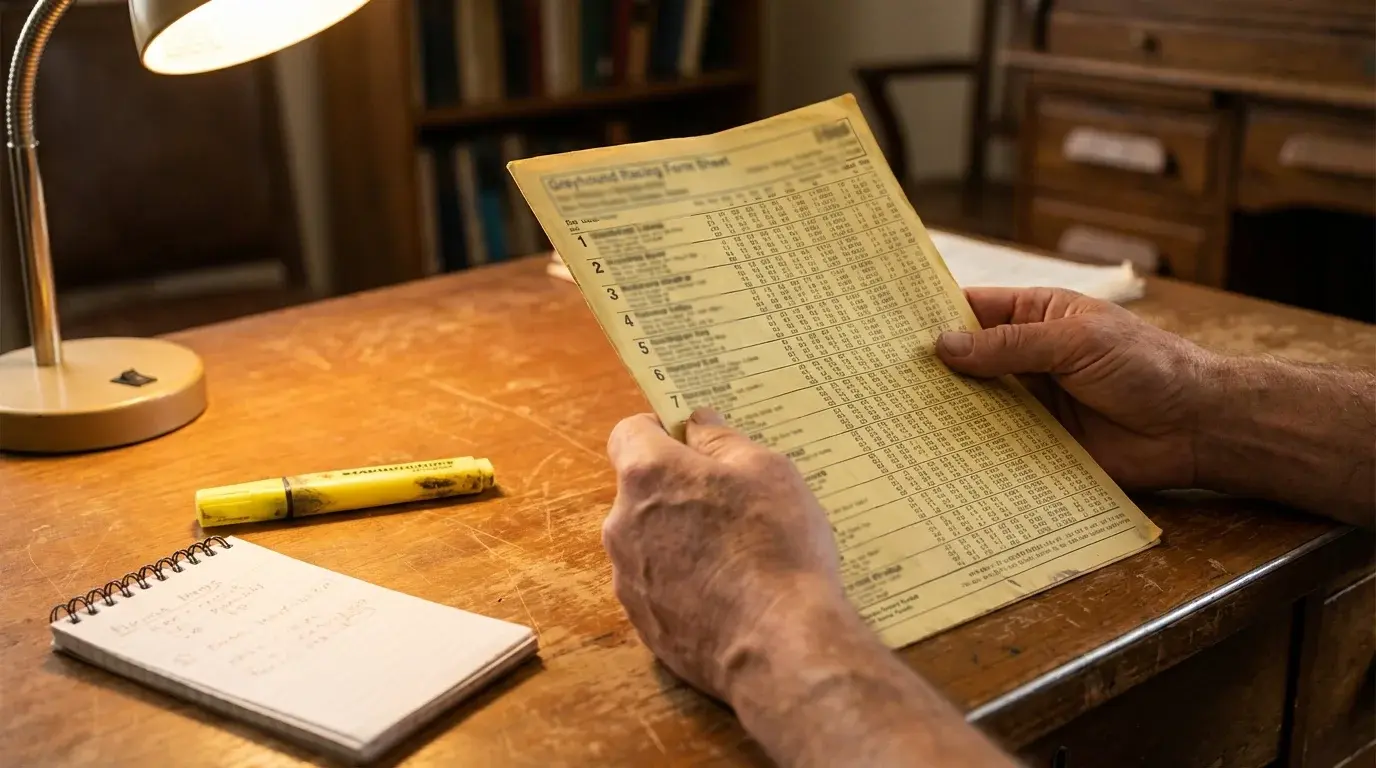
The form string on a standard UK race card shows the finishing positions of a dog’s last five or six runs, reading left to right with the oldest run first and the most recent run on the right. A form line of 231112 tells you the dog has been improving steadily and currently sits on a sequence of strong finishes. A line of 112345 shows the opposite — a dog that was sharp several runs ago but has been declining.
The first question to answer is always about trajectory. Is the form improving, steady or deteriorating? Improving form suggests a dog that is being brought to peak fitness by its trainer, recovering from an injury, or benefiting from a favourable sequence of draws and conditions. Declining form might reflect physical deterioration, increased competition after a grade promotion, or accumulated fatigue from racing too frequently. Steady form — a dog that consistently finishes second or third — often indicates an honest performer that lacks the finishing kick to win but is reliable enough for place-based bets.
Beyond the numbers, most detailed race cards include running comments or codes. These annotations describe how the dog ran — whether it led from the traps, was crowded at the first bend, ran wide through the back straight, or closed strongly in the final 50 metres. The annotations transform a raw number from a verdict into a story. A fourth-place finish accompanied by “baulked on the first bend, closed strongly in the straight” is fundamentally different from a fourth-place finish where the dog ran a clean race and simply was not fast enough.
One common mistake is giving too much weight to a single result. Greyhound racing is high-variance. Dogs bump each other, stumble, or get caught in traffic. A single poor run does not invalidate a strong sequence of results. Equally, a single win does not prove a dog has turned a corner. The reliable signal comes from patterns across three or more races: consistent improvement, consistent speed, consistent finishing positions. Isolated results, whether good or bad, are noise until confirmed by repetition.
Pay particular attention to form at the specific track and distance the dog is running today. A dog that has won three of its last five races at Romford over 400 metres is a more compelling selection for another 400m race at Romford than a dog with the same win count spread across different venues and distances. Track familiarity and distance suitability are real factors in greyhound performance, and form analysis that ignores them is working with incomplete data.
Sectional Times and Pace Analysis
Finishing time is the bluntest measure of performance. Sectional times are where the analysis sharpens. Most UK race cards split the race into two phases: the time to reach the first bend (the “run-up” or “first sectional”) and the overall finishing time. The difference between these tells you whether a dog runs its race early or late.
A dog that posts a fast first sectional but a modest overall time is an early-pace runner — it breaks fast from the traps, takes the lead to the first bend, and then holds on as long as it can. These dogs benefit from clean breaks, inside trap draws, and shorter distances where there is less time for closers to make up ground. An early-pace dog drawn in a favourable trap with a clear path to the first bend is often a strong win bet. The same dog drawn in a congested middle trap, where it is likely to be bumped or slowed at the break, is significantly less reliable.
The opposite profile is the closer: a dog with a relatively slow first sectional but a fast overall time. This dog lets the field go, saves energy through the first bend, and accelerates through the back straight and final bend to overhaul the leaders. Closers tend to be less affected by trap draw because they are not competing for the early lead. Their risk is getting caught in traffic — if the dogs ahead slow each other down, the closer benefits; if the field spreads cleanly, the closer may run out of ground.
Comparing sectional times across dogs in the same race is the most direct form of pace analysis. If one dog consistently posts the fastest first sectionals at this track, and no other dog in the field matches that early speed, the early-pace dog is likely to lead to the first bend unchallenged. A clear lead at the first bend is the single strongest predictor of a greyhound race outcome — statistically, the dog leading at the first bend wins more often than any other position.
One caveat: sectional times are only directly comparable at the same venue. A 4.80-second first sectional at Romford is not the same as a 4.80-second split at Nottingham because the distance from the traps to the first bend is different. Always compare times within the same track, and ideally within the same class of race, to get meaningful results.
Grade Context and Opposition Quality
A form line does not exist in a vacuum. A dog showing 333 in A2 graded races is running significantly faster company than a dog showing 111 in A8 races. The numbers alone say the second dog is the better performer. The grade context tells you the opposite is more likely true.
The UK greyhound grading system places dogs in classes from A1 (highest standard at open meetings) down to A11 (lowest). Open races sit above the graded system and attract the sport’s elite. When a dog wins at a lower grade, it gets promoted; when it consistently finishes poorly, it gets demoted. This escalator system means that a dog’s current grade is a lagging indicator of its ability — it reflects where the dog was, not necessarily where it is now.
The grade dropper is one of the most reliable form angles in greyhound betting. When a dog has been racing in a higher grade and is dropped down — usually after finishing mid-pack for several races — the raw form looks poor. But its sectional times, when compared to the lower-grade competition it is now facing, may be comfortably superior. The market often underrates grade droppers because the most visible data (recent finishing positions) looks mediocre. The less visible data (relative speed) tells a different story.
The reverse situation — a dog promoted after a winning streak — requires equal scrutiny. Three wins in A7 does not mean the dog will win in A5. The opposition is faster, more experienced at racing in traffic, and less likely to make positioning mistakes. A promoted dog’s first run in a higher grade is frequently its worst, as it meets genuine competition for the first time in several outings.
When analysing form, always note the grade of each previous race. A form line of 214132 is far more informative when you know the first three runs were in A3 and the last three were in A5. The dip in the middle may simply reflect the step up in class, and the improvement at the end could indicate the dog finding its level after being misgraded for a few weeks.
The Dog That Improved Last Week
Form analysis is not an archive exercise. It is about prediction, and prediction requires identifying dogs that are moving in the right direction — specifically, dogs that showed meaningful improvement in their most recent run. A single improved run is not conclusive, but it is a signal worth monitoring, particularly when other factors align.
The most valuable improvement signals are: a significantly faster overall time compared to the previous two runs at the same distance and track; a higher finishing position combined with faster sectionals, which indicates genuine performance improvement rather than just a lucky run; and a clean run after a sequence of interference-disrupted races, which suggests the dog’s underlying ability has been masked by race-day traffic rather than absent.
Weight is a useful cross-reference here. If a dog improved last time out and its weight is stable or slightly reduced compared to the previous run, the improvement is more likely to be genuine — the dog is fit and sharp. If the improvement coincided with a large weight swing, treat it with more caution.
The most overlooked aspect of form analysis is knowing when to stop looking. Not every race card produces a confident selection. When the form is ambiguous, the grades are shifting, the sectional data is inconsistent and no dog shows a clear edge, the correct analytical conclusion is to not bet the race. Form analysis is not about finding a reason to bet every race. It is about finding the races where the data gives you a genuine informational advantage — and having the discipline to wait for them.