 Available in US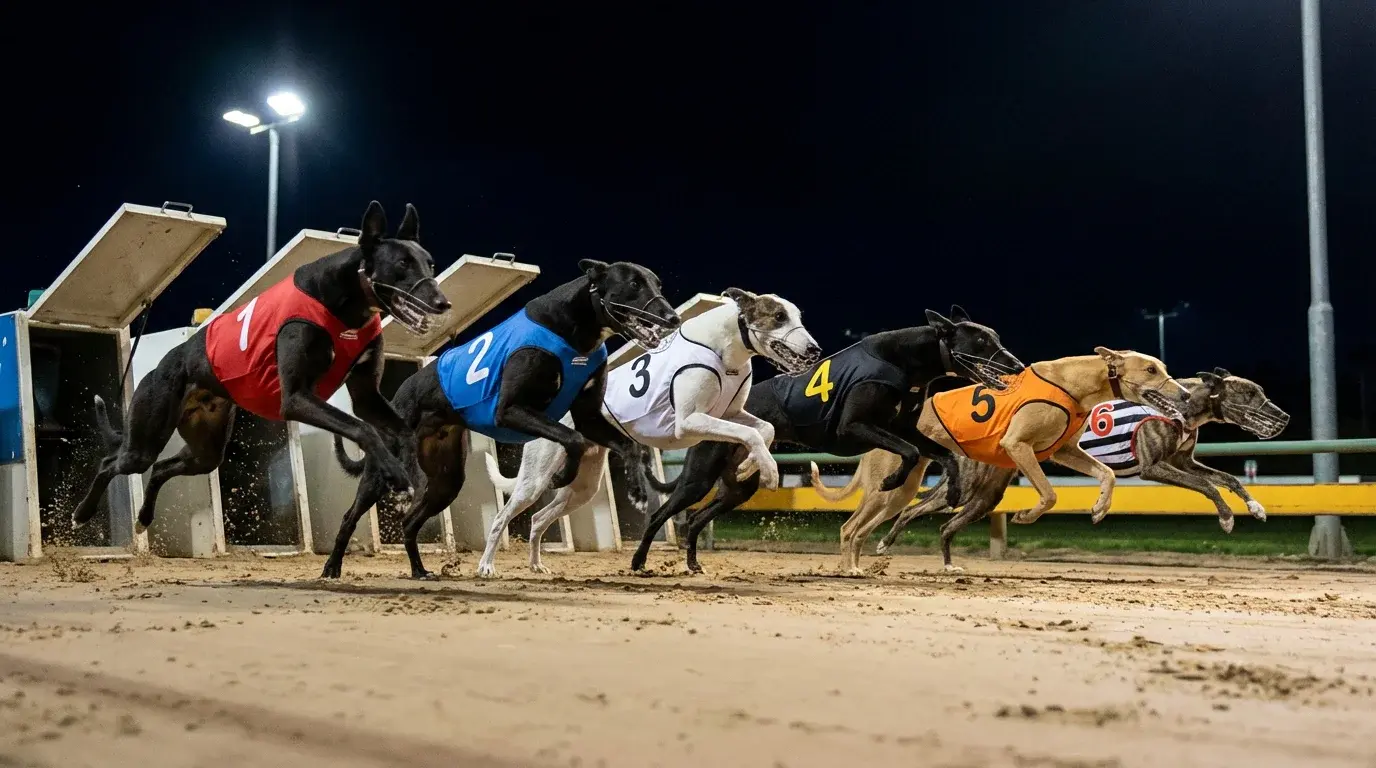
A greyhound race lasts about thirty seconds. The in-play betting window is even shorter. From the moment the traps open to the point where the market suspends — usually somewhere around the first bend — you have a handful of seconds to make a decision, confirm a bet, and hope the platform processes it before the odds vanish. This isn’t football, where you can watch ten minutes of a half and reassess. It’s closer to trading on a micro-exchange where the entire session is over before your coffee gets cold.
In-play greyhound betting exists on most non-GamStop platforms that offer live racing, but the experience varies enormously. Some bookmakers provide genuine live markets with real-time odds updates. Others offer a token in-play option that’s more marketing than function — odds that update once or twice after the off, with bet acceptance so slow that the race is over before your slip is confirmed. Knowing the difference between these two experiences is the first step toward making in-play work as a betting approach rather than an expensive reaction to watching dogs run.
This guide covers how in-play greyhound markets actually operate, what the odds movements tell you if you can read them quickly enough, and how to use cash-out features without giving away the value you’ve built.
How In-Play Greyhound Markets Open and Close
In-play markets for greyhound racing follow a compressed timeline that looks nothing like other sports. In football, in-play betting runs for ninety minutes plus stoppage time. In tennis, it spans sets and games. In greyhound racing, the live window is measured in seconds, and the practical window for placing a bet and having it accepted is even narrower.
The pre-race market is where most greyhound betting happens. Odds are available from the time the race card is published — sometimes hours before the off — and they firm up in the final minutes as money flows in. The pre-race market typically suspends a few seconds before the traps open. At that point, no new bets are accepted until the in-play market opens, which happens the moment the traps release. On platforms with robust in-play systems, odds update continuously based on the positions of the dogs in the race. On less sophisticated platforms, the market may only update once or twice — or not at all — before it closes again.
The suspension point varies. Most bookmakers suspend in-play greyhound markets after the first bend, which means you have roughly five to eight seconds of live betting on a standard sprint race. On longer distances — 500 metres and above — the window might extend to ten or twelve seconds. But these are generous estimates. In practice, latency between the live feed and the odds engine, combined with the time it takes to select a bet and confirm it, reduces the actionable window to three or four seconds at best. If you’re watching a delayed stream, the window may already be closed by the time you see the traps open.
This is why platform selection matters so much for in-play greyhound betting. A bookmaker with direct data feeds from the track and low-latency bet processing gives you a genuine opportunity to act on what you see. A bookmaker running a delayed stream with manual odds updates gives you the illusion of in-play betting without the substance. The difference is invisible in the marketing copy but obvious the moment you try to place a bet mid-race and receive a “market suspended” message for the third time in a row.
On betting exchanges, the in-play dynamic is different again. Exchanges like Betfair keep markets open throughout the race, but liquidity in greyhound markets is thin compared to horse racing. You might see offers to back or lay at certain odds, but the amounts available are small, and the odds shift violently as the race develops. Placing a matched bet during a live greyhound race on an exchange requires both speed and a willingness to accept that your order may not be filled. Unmatched bets sit in the market until the race ends and are then voided.
There’s one more factor worth understanding: the difference between “in-play” as a betting term and “in-running” as a market descriptor. Some platforms use these interchangeably. Others distinguish between pre-race live odds adjustments — where the market is technically open but the race hasn’t started — and genuine in-running markets where the dogs are moving. When evaluating a non-GamStop platform’s in-play offering, check whether greyhound markets are listed as in-running or simply as pre-race with live updates. The label tells you what kind of window you’re actually getting.
Reading Live Odds Movement
Odds in a live greyhound market move for exactly one reason: the race is happening, and positions are changing. Unlike pre-race markets, where odds shift based on money flowing in from bettors, in-play odds shift based on what’s actually occurring on the track. A dog that breaks sharply from the traps and leads into the first bend will see its odds shorten immediately. A dog that stumbles at the start or gets boxed in will drift. The speed of this adjustment depends on the quality of the bookmaker’s pricing algorithm and how closely it mirrors reality.
For bettors watching a live stream, the key is understanding what the odds are reacting to — and how much of that information you can actually use. The first two seconds after the traps open tell you about early pace. If a dog that was 3/1 pre-race breaks first and shows clear early speed, its in-play price might drop to 6/4 or shorter almost instantly. The question is whether that shortened price still represents value, or whether the market has already absorbed the information you’re seeing. In most cases, by the time you’ve registered the break, assessed the position, and moved to place a bet, the odds have already adjusted past the point of value. This is the central challenge of in-play greyhound betting: the information advantage is real, but the execution window is almost non-existent.
There are scenarios where in-play odds do offer genuine opportunity. The most common is when a pre-race favourite breaks poorly. If a heavily backed dog — say, priced at evens — gets squeezed at the first bend and drops to fourth or fifth, its in-play price will balloon to 5/1 or higher. If you’ve done your homework and believe the dog has the class and pace to recover — perhaps it’s a known late closer running over 500 metres — then backing at that inflated price can represent serious value. You’re betting against the panic of the market, which has written off a dog that still has twenty seconds of racing ahead of it.
The opposite scenario also exists. A dog that breaks well from trap one might be leading into the bend at very short odds — say, 1/3 in-play. The market is pricing in its current position, but if you know that this track’s bend configuration tends to favour wider runners in the second half of the race, or that the dog typically fades over this distance, the short in-play price might overstate its chances. That’s a lay opportunity on an exchange, not a back bet on a bookmaker, but the logic is the same: the live odds are reacting to position, and your edge comes from knowing what happens next.
Reading live odds movement in greyhound racing is ultimately a skill that rewards preparation more than reaction time. If you’ve studied the race card, know each dog’s running style, and have a view on which dogs are likely to be prominent early versus those that close late, the in-play odds become a confirmation tool rather than a discovery tool. You’re not watching to learn something new — you’re watching to see whether the situation you anticipated has materialised, and acting on a plan you made before the traps opened.
Cash-Out Tactics in Live Markets
Cash-out on greyhound bets is available on a growing number of non-GamStop platforms, though the implementation ranges from sophisticated to barely functional. The basic premise is simple: if you’ve placed a pre-race bet and the race is about to start — or has started — the bookmaker offers to settle your bet early at a calculated price. That price reflects the current odds, the remaining race distance, and the bookmaker’s margin. It’s always less than the full potential return if your dog wins, but it’s guaranteed money versus the uncertainty of the remaining race.
The decision to cash out is one of the few moments in greyhound betting where real-time judgment genuinely matters. Consider a scenario: you’ve backed a dog at 4/1 pre-race. The race is underway, your dog is leading after the first bend, and the cash-out offer sits at around 70% of your full return. Do you take it? The answer depends on three things — your assessment of the dog’s ability to hold its position, the behaviour of the dogs behind it, and how much the guaranteed amount means relative to your bankroll.
Most cash-out regret comes from the wrong framing. Bettors who cash out and then watch their dog win feel they’ve left money on the table. Bettors who don’t cash out and watch their dog get caught on the run-in feel they’ve been greedy. Neither reaction is particularly useful. The correct framing is probabilistic: at the point you made the cash-out decision, what was the dog’s likely chance of winning from its current position? If the cash-out offered more than the expected value of holding, cashing out was correct. If it offered less, holding was correct. That your dog subsequently won or lost is irrelevant to whether the decision was sound.
Partial cash-out is more interesting for greyhound bettors who want to balance risk and reward. If your platform offers it, partial cash-out lets you lock in a portion of your return while leaving the rest running. On a 4/1 selection that’s leading at the bend, you might cash out half your bet for a guaranteed profit and let the other half ride. If the dog wins, you collect a reduced but still meaningful full payout on the remaining portion. If it loses, you’ve already banked something. This is particularly useful in longer races — 500 metres and above — where the outcome is less certain even when a dog leads early.
A few practical cautions. Cash-out prices are not calculated in your favour. The bookmaker builds its margin into the cash-out offer just as it builds margin into the original odds. The offer will always be slightly below the mathematically fair value. That’s the cost of the guarantee. Also, cash-out availability during in-play greyhound racing is not universal. Some platforms only offer cash-out pre-race or in the first few seconds of the race, and the option disappears before the first bend. Others maintain it throughout but with such rapid price changes that the amount you see on screen and the amount you actually receive may differ. Always check whether the cash-out figure is locked at the moment you click or subject to final confirmation at the updated price. That distinction, on a platform with volatile in-play odds, can mean the difference between a profitable exit and a frustrating one.
Speed Kills the Unprepared
In-play greyhound betting rewards a very specific kind of bettor: someone who does their preparation before the race, makes decisions based on scenarios rather than reactions, and treats the live market as a place to execute plans rather than form opinions. If you’re watching the race to figure out what’s happening and then trying to bet on it, you’re already too late. The market is faster than your observation, and the execution window punishes hesitation.
That doesn’t mean in-play is reserved for professionals or algorithmic bettors. It means the approach has to be different from pre-race betting. Before the traps open, you should already know which dogs are likely to lead, which are closers, and what scenarios would make a live bet worthwhile. “If the favourite breaks poorly and drifts past 3/1, I’ll back it because it has the sectional speed to recover over this distance.” That’s a pre-race plan executed in-play. It’s specific, it’s conditional, and it removes the need to think under time pressure.
The bettors who lose money consistently on in-play greyhound markets are the ones who use it recreationally — placing bets mid-race because the race is on and the option is there. Speed kills the unprepared in this market more reliably than in any other form of betting. But if your preparation is done, if your conditions are set, and if you’re disciplined enough to only act when those conditions are met, in-play greyhound betting becomes one of the sharpest tools available on any platform. The edge isn’t in the speed of your click. It’s in the quality of the homework you did hours earlier.
Find more in-play guides at greyhoundnotgamstop.
Also read our live streaming greyhound racing.
