 Available in US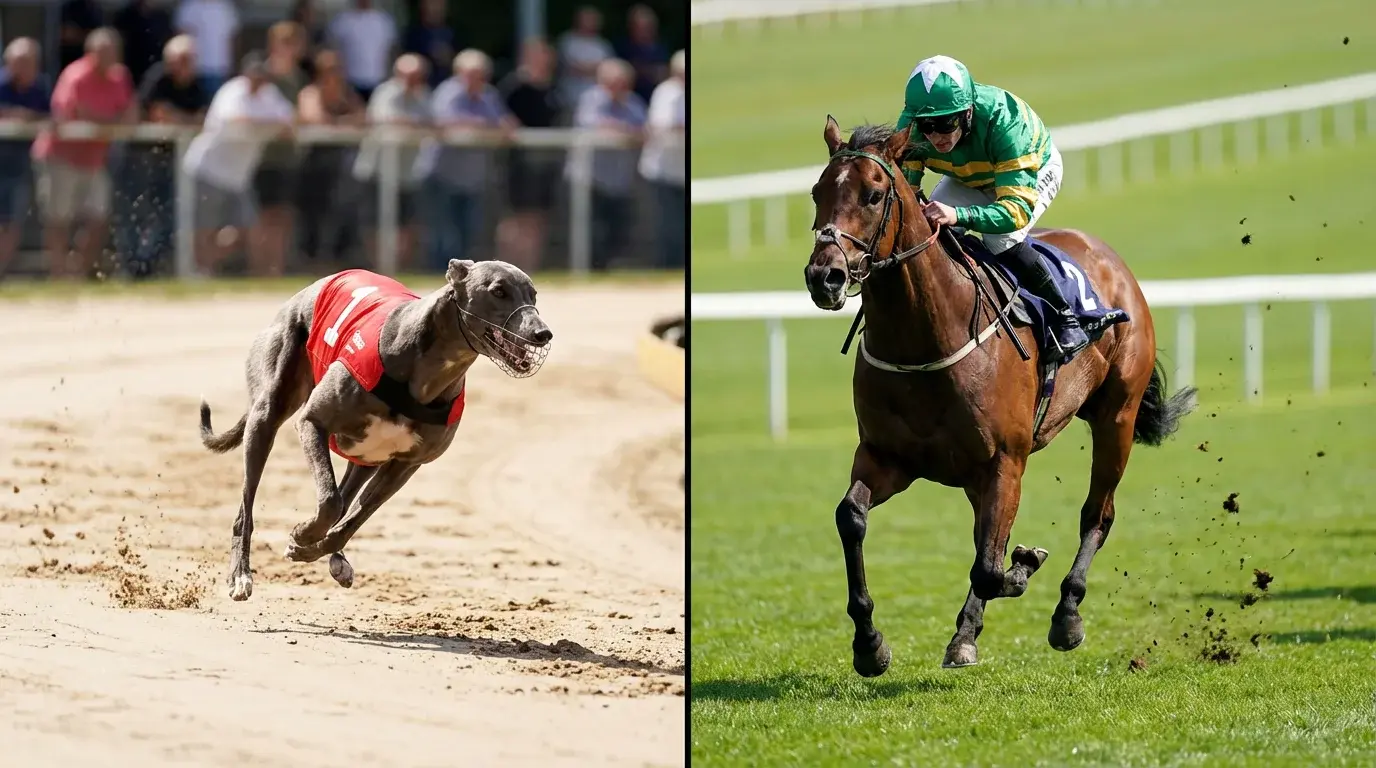
Horse racing and greyhound racing share a surface structure — animals run around a track, the first to cross the line wins, and punters bet on the outcome. Beneath that surface, the two sports produce fundamentally different betting experiences. The field sizes are different. The race frequency is different. The form data is different in both depth and volatility. The odds markets behave differently. And the analytical skills that generate an edge in one sport do not always transfer cleanly to the other.
For punters who come to greyhound betting from a horse racing background — or who are considering splitting their activity between both — understanding these structural differences is not academic. It directly affects which strategies work, how bankrolls should be sized, and where the most accessible value tends to sit. The two sports look similar from a distance. Up close, they demand different things.
Field Size and Its Impact on Odds
The most consequential structural difference is field size. A standard UK greyhound race has six runners. A standard UK horse race can have anywhere from four to over twenty, with handicap races at festivals routinely fielding 16 to 20 runners. This single variable cascades through every aspect of the betting experience.
In a six-dog greyhound race, the baseline probability for any random selection winning is approximately 16.7%. In a 16-runner horse race, it drops to 6.25%. This means that a greyhound punter starts with a structurally higher strike rate before any form analysis enters the picture. Even a modestly skilled greyhound bettor backing selections at random would win more frequently than a modestly skilled horse racing bettor doing the same — though neither would be profitable without an edge over the market.
The odds reflect this. Greyhound favourites typically range from even money to 5/2, with outsiders rarely exceeding 10/1 or 12/1 in a six-dog field. Horse racing favourites can range from short odds-on to 4/1 or beyond, with outsiders stretching to 33/1, 50/1 or longer in big-field handicaps. The compressed odds range in greyhound racing means that individual wins produce smaller returns than in horse racing, but the higher strike rate compensates — the bettor wins less per bet but wins more often.
For betting strategies, this matters in concrete ways. Each-way betting is structurally different across the two sports. In a six-runner greyhound race, each-way terms typically cover two places at 1/4 odds. In a 16-runner horse race, each-way may cover four places at 1/4 or even 1/5 odds, with considerably longer place prices. The risk-reward profile of each-way shifts significantly between sports, and a punter whose each-way approach was developed for horse racing needs to recalibrate expectations when applying it to greyhounds.
Forecasts and tricasts also behave differently. With six runners, there are 30 possible forecast combinations and 120 possible tricast combinations. With 16 runners, the forecast permutations leap to 240 and the tricast permutations to over 3,000. The practical consequence: forecast and tricast betting is substantially more viable in greyhound racing because the smaller field means form analysis can realistically narrow the contenders to a handful, making precise finishing-order bets feasible rather than speculative.
Race Frequency and Betting Volume
UK greyhound racing runs virtually every day of the year, with BAGS daytime meetings, afternoon sessions and evening cards across multiple tracks. A typical day might offer 60 to 80 individual greyhound races from six or seven venues. Horse racing runs on a more compressed schedule — around 30 to 50 races per day during the flat season, fewer during the winter jumps season, and dark days with no racing at all.
The sheer volume of greyhound racing creates both opportunity and risk. The opportunity is that more races mean more chances to find value — more data points for form analysis, more markets with potential pricing errors, and more occasions to apply a proven strategy. The risk is that the volume tempts punters into overbetting, placing wagers on races they have not properly analysed simply because the next race is always five minutes away.
Horse racing’s lower frequency imposes a natural discipline. With fewer races available, most horse racing bettors are more selective by default — they study the card, identify their fancies, and wait for the right moment. Greyhound racing requires the bettor to impose that selectivity on themselves, because the platform will never run out of races to bet on. This is a genuine difference in the psychological demands of the two sports, and punters transitioning from horses to dogs frequently underestimate how much the availability of constant action affects their decision-making.
Betting volume in the market itself differs too. Horse racing attracts significantly more money, particularly on premium meetings (Royal Ascot, the Cheltenham Festival, the Grand National). This higher liquidity makes horse racing markets more efficient — mispricing is corrected faster, and finding value requires deeper analysis. Greyhound markets are thinner, particularly for lower-grade races, which means prices are less efficiently set and opportunities for the informed bettor persist longer before being corrected.
Form Complexity — Dogs vs Horses
Horse racing form is a deep and multidimensional dataset. A single horse’s form record might span several years, covering dozens of runs across different tracks, going conditions, distances, jockeys, weights and race classes. The variables are numerous — the going (firm, good, soft, heavy), the draw (on flat tracks), the jockey’s form, the trainer’s form, the distance, the weight carried in handicaps — and the interactions between these variables create a complex analytical challenge that rewards specialists.
Greyhound form is simpler in structure but higher in volatility. A dog’s record shows finishing positions, sectional times, trap draws and grades — fewer variables than horse racing, but each variable matters more on a per-race basis because the margin between dogs in a six-runner field is thinner than between horses in a 16-runner handicap. The interference factor is also more prominent in greyhound racing: crowding at the first bend, bumping on the back straight and physical contact between runners are routine rather than exceptional, and they introduce a randomness that form analysis cannot fully predict.
The jockey variable illustrates the difference well. In horse racing, the jockey is a skilled athlete whose tactical decisions during the race can override the horse’s natural running style. A top jockey on a moderate horse regularly outperforms a moderate jockey on a talented horse. In greyhound racing, there is no jockey. Once the traps open, the dog runs on instinct, training and physical ability. There is no human decision-maker adjusting the race plan in real time. This makes greyhound racing more mechanistic — outcomes depend more on pre-race conditions (trap draw, form, fitness) and less on in-race adaptation.
For the bettor, this means that greyhound form analysis is faster to learn but harder to master in terms of managing the inherent randomness. Horse racing form analysis has a steeper learning curve but, once learned, offers more dimensions to exploit. A greyhound specialist might spend 15 minutes analysing a race card. A horse racing specialist might spend 45 minutes on a single race. The payoff per minute of analysis is arguably higher in greyhound racing because the competition among analysts is thinner.
Which Racing Suits Your Betting Style?
The question is not which sport is better for betting. It is which sport’s structural characteristics align with how you prefer to bet.
If you prefer a high-frequency, lower-variance approach — placing several bets per session, accepting smaller individual returns, and grinding a profit through volume and consistency — greyhound racing is the more natural fit. The six-dog fields produce a higher strike rate, the compressed odds keep individual swings manageable, and the sheer number of daily races provides ample opportunity to apply a systematic method.
If you prefer a lower-frequency, higher-variance approach — studying a small number of races in depth, backing fewer selections at potentially longer odds, and accepting larger swings in exchange for bigger individual wins — horse racing offers more scope. The larger fields, wider odds ranges and deeper form data reward the patient analyst who is willing to wait for the right opportunity and back it with conviction.
Many successful punters bet on both sports, applying different strategies to each. A common pattern is to use greyhound racing for day-to-day betting with a systematic, data-driven method, while reserving horse racing for event-specific analysis around the major festival meetings. The two sports complement each other rather than compete, provided the bettor adjusts their staking, their expectations and their analytical approach to the structural reality of each.
The worst approach is to treat one sport as if it were the other. Applying horse racing handicap analysis to a greyhound race produces confusion. Applying greyhound sectional-pace analysis to a horse race ignores the variables (going, weight, jockey) that dominate outcomes in that sport. Learn each sport on its own terms, respect the structural differences, and let the data — not habit — guide which races receive your money.
Find more betting guides at greyhoundnotgamstop.
Also read our greyhound betting article.
