 Available in US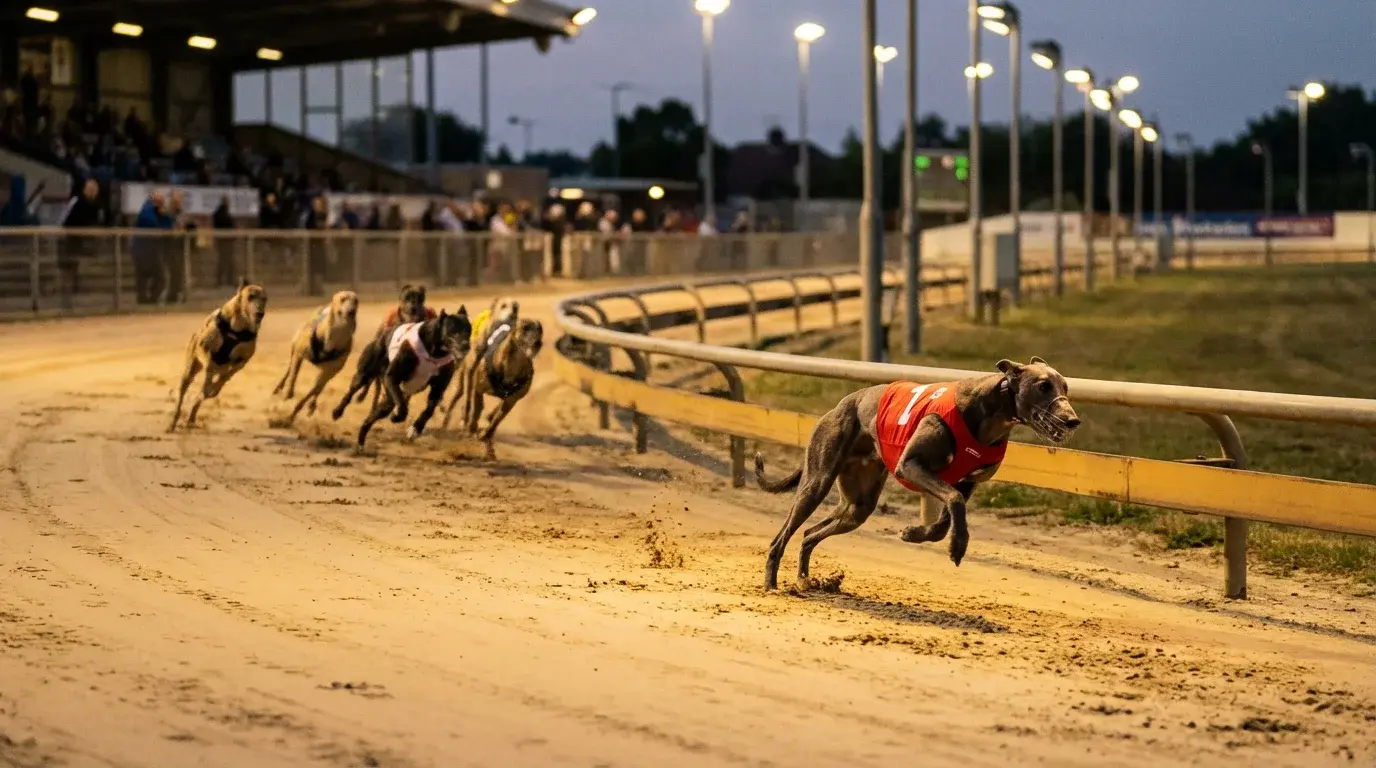
Every greyhound race is a contest between two fundamental running styles: the dog that wants to lead from the traps and the dog that wants to come from behind. These are not personality quirks. They are biomechanical realities — products of breeding, physiology and training that dictate how a dog distributes its energy across 25 to 35 seconds of flat-out running. One style ignites early. The other ignites late. Neither is inherently superior, but each performs differently depending on the trap draw, the distance, the track geometry and the composition of the field it faces.
Understanding which style a dog runs — and how that style interacts with the conditions of today’s race — is one of the most direct analytical advantages available to greyhound bettors. The race card tells you finishing positions. The sectional times tell you running style. And the running style, mapped against the specific race conditions, tells you whether the form figures are likely to repeat or reverse.
What Defines an Early-Speed Dog
An early-speed dog breaks fast from the traps, reaches the first bend at or near the head of the field, and attempts to hold that position through the remainder of the race. Its energy output is front-loaded — the fastest portion of its run is the first 100 to 150 metres. This is visible in the sectional times: a dog posting a first-bend split of 4.60 seconds when the field average is 4.80 has a clear early-pace advantage.
Early speed in greyhounds is partly innate and partly developed. Certain bloodlines produce dogs with explosive acceleration out of the boxes. Training reinforces this by conditioning the dog to associate the trap opening with maximum effort. The result is a runner that can gain two or three lengths in the first 50 metres — an advantage that, at most UK tracks, translates directly into a clear run to the first bend with no traffic to navigate.
The value of early speed in greyhound racing is well documented. Across the UK circuit, the dog that leads at the first bend wins the race more often than any other position. The exact percentage varies by track, but at most venues, the first-bend leader converts at somewhere between 35% and 45%. This is a powerful statistic, and it explains why the market consistently prices early-pace dogs as shorter odds when drawn in inside traps — the combination of fast breaking speed and a short path to the rail is the single most favourable setup in the sport.
But early speed carries vulnerabilities. The most obvious is trap draw. An early-pace dog drawn in trap 5 or 6 at a track with a tight first bend faces a longer path to the rail and more dogs between it and the inside. If another early-pace dog is drawn inside, the two may race for the lead and crowd each other, spending extra energy in the process. The market often underestimates this risk — a fast dog in a wide trap still looks good on form but may be structurally disadvantaged today.
Fatigue is the other vulnerability. Dogs that expend maximum energy in the first phase have less in reserve for the closing stages. Over shorter distances — 265 metres, 285 metres — this barely matters because the race is over before the energy deficit becomes apparent. Over 480 metres and especially over 600 metres or more, early-speed dogs face a genuine risk of being overtaken in the final 100 metres by dogs that conserved energy through the first half. The distance of the race is therefore a critical variable when assessing early-speed form: a dog that leads and wins over 265 metres is not guaranteed to reproduce that dominance over 480 metres at the same track.
Late Closers and When They Strike
A late closer runs the opposite energy profile. It breaks from the traps at moderate speed, settles into a position behind the leaders through the first bend, and then accelerates through the back straight and final bend to close the gap. Its fastest running comes in the second half of the race, and its sectional times reflect this: a modest first-bend split followed by a strong overall finishing time.
Closers depend on two things happening in front of them. First, the leaders must slow down — either because they have exhausted their early-pace reserves, because they are crowding each other for the lead, or because the track conditions (wet surface, headwind on the back straight) are draining their energy faster than usual. Second, there must be clear running available for the closer to move through — a closing lane on the outside, or gaps between tiring dogs that the closer can exploit.
When both conditions are met, closers can produce spectacular late surges that overturn what looked like a settled result. A dog sitting fifth at the first bend can sweep through the field on the final straight and win by a length or more. These finishes are dramatic for spectators and profitable for bettors who identified the closer’s potential before the race.
When the conditions are not met, closers lose. If the leader breaks cleanly, finds the rail, and runs an honest pace without interference, the closer simply runs out of ground. The closer may post the fastest final sectional in the race and still finish third or fourth because the leader’s advantage at the first bend was too large to overcome. This is the fundamental risk of betting on closers: they need help from the race dynamics, and that help is not guaranteed.
The form card for a closer typically shows more variability than for an early-pace dog. You will see scattered wins interspersed with mid-pack finishes — first, fourth, first, fifth, second. This pattern is not inconsistency. It is the closer’s running style colliding with different race scenarios. In races where the pace collapsed, the closer won. In races where the leader held on, the closer was beaten despite running well. Reading a closer’s form requires looking past the finishing positions to the sectional data and the running comments, which reveal whether the dog actually ran poorly or was simply a victim of pace dynamics beyond its control.
How Distance and Track Shape Favour Each Style
Distance is the most straightforward variable. Sprint races (under 300 metres) overwhelmingly favour early-speed dogs because there is simply not enough track for closers to make up ground. By the time a closer reaches top speed, the race is nearly over. Over standard distances (400 to 500 metres), the balance shifts towards a more even contest — early-pace dogs still win more often, but closers have enough runway to close the gap if the leaders tire. Over marathon distances (600 metres and above), closers gain a structural advantage because the race is long enough for early energy expenditure to catch up with the front-runners.
Track geometry interacts with distance. A track with a long run from the traps to the first bend gives early-speed dogs more time to establish a lead, which favours them. A track with a short run to a tight first bend creates congestion that can disadvantage wide-drawn pace dogs and benefit closers sitting behind the traffic. The angle of the bends matters too: tight bends favour railers and dogs already on the inside (typically early-pace dogs that led to the bend), while wider, more sweeping bends allow closers to maintain momentum through the turn rather than checking their stride.
Surface condition adds a dynamic layer. Wet, heavy going saps energy from front-runners faster because each stride requires more effort against the resistant surface. Closers, running in the second half of the race when the pace has already slowed, are less affected in relative terms. Dry, fast surfaces favour the opposite — early-pace dogs can build leads that closers struggle to erode because the energy cost of maintaining speed is lower.
The practical takeaway: early-speed form is more reliable when the distance is short, the trap draw is favourable, the track has a long run to the first bend, and the surface is dry. Closer form is more reliable over longer distances, at tracks with tight first bends that create traffic, and on wet or heavy going. Matching the running style to the conditions is where the analytical edge sits.
The Race Is Not Always Won at the First Bend
Statistics say the first-bend leader wins more often than any other position. Statistics do not say it wins every time. Somewhere between 55% and 65% of races are won by dogs that did not lead at the first bend, which means the majority of races are decided by what happens after the initial positional battle.
For bettors, this is both a caution and an opportunity. The caution is against overrating early speed in every scenario. A dog with blazing first-bend splits drawn in trap 1 on a fast surface is a strong proposition — but at cramped odds, it may not represent value if the market has already priced in the advantage. The opportunity is in identifying closers whose form figures look mediocre but whose sectional data reveals genuine closing ability that is being disguised by unfavourable race dynamics.
The most profitable running-style bets are the mismatched ones: an early-pace dog whose odds are too long because its recent form includes a run from a wide trap that suppressed its natural style, or a closer whose odds are too long because its last three races were over sprint distances that gave it no chance to close. In both cases, today’s conditions — a favourable trap or a suitable distance — restore the dog’s natural advantage, and the odds have not adjusted because the market is reading the raw form rather than the underlying style.
Running style is not a label. It is an analytical lens. Apply it to every dog in the field, compare it to today’s conditions, and use it to adjust the probabilities that the form figures alone suggest. The first bend matters. What happens after it matters just as much.
Get more form guides at greyhoundnotgamstop.
Also read our greyhound form guide.
